활동소식

The White house is opening up, the Blue house is under construction?!

2011.07.18

Jung Tae Young

The energetic member Jung Tae Young is a student in Chung Ang University studying at documents and records grads school. She is not just a student that reads books in research labs but is our member that also agonizes about the current society and participates actively. We always thank you! 😀


Translated by SOORIN KIM(voluntarily activist)
Open Government is the new trend in America.
Open Government is a new trend in Korea too.

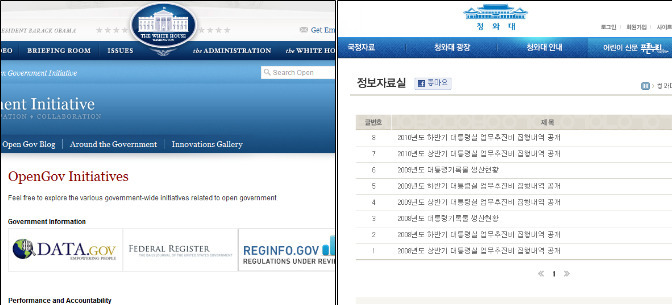
It sounds like the same ‘Open Government’ but the enormous differences can be seen in the White House homepage.

This is a where the ‘Open Government Initiative’ is introduces in the website. The Obama administration completed the Memorandum on Transparency and Open Government June 2009 and gathered of June public consensus. Finally, December 2012, published ‘Open Government Directive’ which collected both the government and citizens’ opinion.

This directive contains online public information of government(timely public information promotion for citizens’ search and download without obstacles by open format), improvement in quality of information(secure transparency of federal government’s spending by focusing on quality of information regarding the expenditures of each departments and objectivities), promotion of government’s open culture and institutional settlement of it(federal open government dashboard to share domestic and foreign advanced examples), establishment of political framework to expand transparent publicity of government(improvement in laws and political framework for reinforcement of national competence through development of information technology).

As to this, main departments released ‘Open Government Flagship Initiatives’ and all the results are all here in this website. Through this site, the White House’s transparency, participation and collaboration are all realized.

To begin with, DATA.COM is a data center that opens not only the raw data such as transportation, medicine, crime, obesity, employment or health but also tool data and geographical data. Even expanding from this, IT DASHBOARD(ir.usaspending.gov) provides federal government’s information budget, RECOVERY.GOV(recovery.gov) provides information about government’s spending on economy which is 82 billion and USA SPENDING.GOV(usaspending.gov) provides information on public tax regulation and usage. Challenge.gov(challenge.gov) is to listen to people’s opinion on problems government departments or institutions are having. When the government offers prize and the problem project to solve, people use the information in DATE.GOV to suggest ideas or solutions.

The United States of America share this numerous data sets in forms of linked data. Also, through public contest the government is making trend that produce additional values by idea sites, applications or visual services. New York is awarding inventors that create new, helpful and commercial applications with public information.

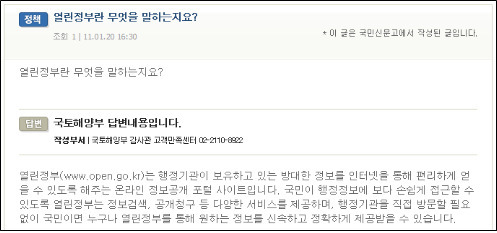
What is Korean open government then? There is an answer in the Q&A of ‘The People’s Voice’. They say that the public information system(www.open.go.kr) is the open government. We can see the enormous difference between America and Korea both visually and level(both quantity and quality).
Public Information Support Center(www.pisc.or.kr) created last year also shows the difference. The organization shows the list of 351 cases of information database and talk as if it’s going to open them all. It’s like ‘the pie in the sky’. In reality, the information can only be open if one goes through three obstacles called registration, notification whether or not the information can be opened, and the negotiation of forms of providing the information.

Korean open government is still under construction just as Data.go.kr is right now.

original Korean version of this post and attached files

*short supplement.

This column written in April last. And recently, Data.go.kr is shown up its vulnerable and contrary to expectation substance.
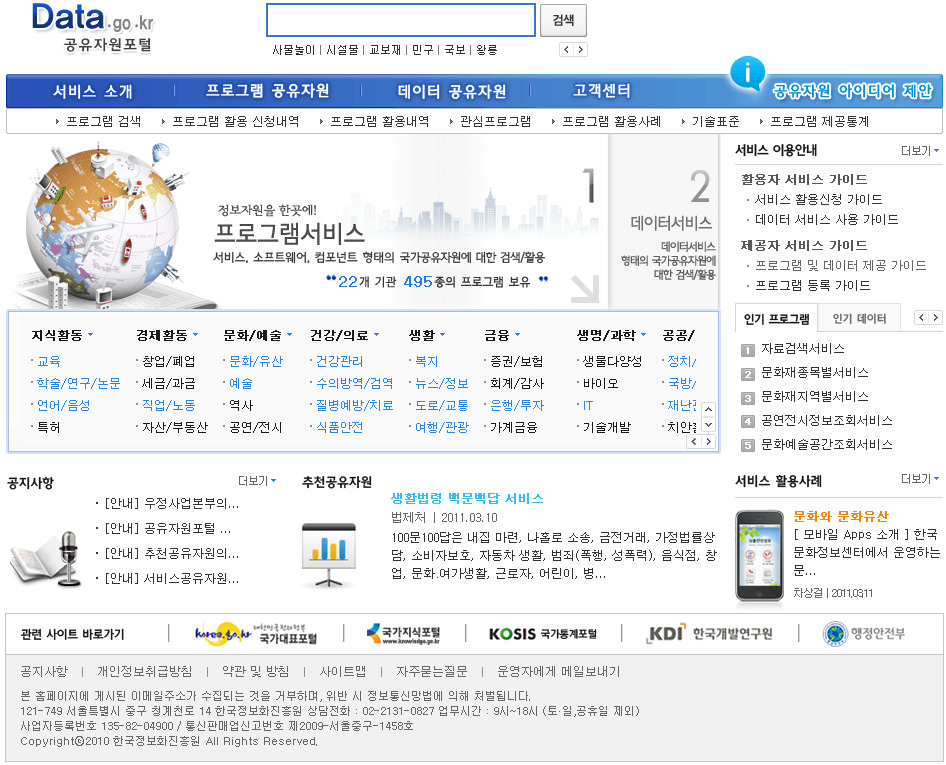
Data.go.kr doesn’t providing information and data of most central governments and local governments regarding administration or execution of the budget. It generally provides public services for life information or convenience information searching.


 

by
  • 정보공개센터

정보공개센터는 정부지원 0%, 시민의 후원으로 활동합니다

후원하기
활동소식

What’s up with the gas mileages of official vehicles?

2011.07.14


             Seoul special city mayor Oh Sae-hoon (image: http://newsen.com

Translated by SOORIN KIM(voluntarily activist)


Time when gas price jumps to 2000 won per liter! On this count, it seems
natural that citizens are using public transportation more frequently and gas
mileage has become the most important point of reference when choosing new cars.


What about the fuel efficiency of the mayors and governors of the local
government and the local police chief’s official vehicles then? The Center for
Freedom of Information and Transparent Society (CFOI) looked into it by filing
FOIA request for the information about official vehicles. CFOI specifically
asked for mileages and gas expenses of the mayors, governors and police chiefs in
Seoul city and Incheon, Gyeonggi province from January 2010 to May 2011.


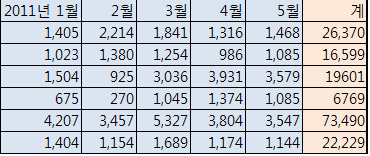
official vehicles mileage and refueling expense of the local government heads in Seoul, Incheon and Gyeonggi  from January 2010 to May 2011


During one year and a half, the official vehicle of the Mayor of Seoul ran
26,370km in total. Refueling expense was 16.59 million won. Mayor of Incheon’s
official vehicle ran 19,601km in total and used 6.76 million won on refueling.
As he rode less than the Seoul Mayor, the Incheon Mayor spent less to refuel.
The Gyeonggi governor’s official vehicle ran 73,490km and spent 22.22 million won
on gas expenses.


Now, let’s look at the mileage and refueling expenses of the police chiefs
in Seoul, Incheon and Gyeonggido.


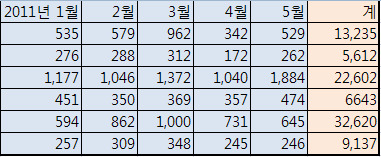
official vehicles mileage and refueling expense of the commissioners of the local police agencies in Seoul, Incheon and Gyeonggido from January 2010 to May 2011


The Commissioner of the Seoul Metropolitan Police Agency’s vehicle ran
13,235km and used 56.12 million won on gas. Incheon Police Agency
Commissioner’s official vehicle ran 22,602km and spent 66.43 million won on refueling.
The chief of the Gyeonggi local Police Agency’ official vehicle ran 32,620km
and the total gas expense was 91.37 million won. Gyeonggi’s chief traveled the
most and thus spent the most on gas too. Sounds legit…


But, when we look closer, we can see that things aren’t so great after
all. 
When we look closer at the table, the Seoul Mayor (26,370km) and the
Commissioner of the Incheon Police Agency (22,602km) ran similar mileages
whereas for the gas expenses, which is 16.59 million won and 6.6 million won
respectively, the difference is as much as about 10 million won. Even if we
take into account the differences in gas prices between the two places, the gap
is simply too much.


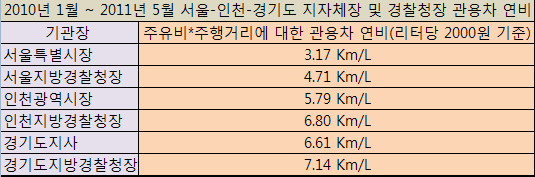
To see things more clearly, we set
the gas price as 2000 won per liter and calculated the estimated fuel
efficiency (km/l) to know how much gas the vehicles use per one liter.


The estimated gas mileage of Seoul Mayor and the Commissioner of the Seoul Metropolitan
Police Agency was quite shocking. In case of the Seoul Mayor, the estimated
efficiency of 3.17km/l was just hard to understand. The Commissioners of Seoul
Metropolitan Police Agency’s estimated efficiency was 4.71km/l, which too seems
to be problematic. The estimated efficiency of Incheon Mayor as well is no higher
than 6km per liter. 


Are we supposed to wonder if the mayor and the commissioner
leave the car engine running during his whole work hours or refuel gas that
costs about 5000 won per liter or something like that? Yes, t
his is just a
rough estimation, but at least one thing is clear now. T
he Seoul Mayor and the
Commissioner of the Seoul Metropolitan Police Agency have wasted gas expenses
awfully.


original Korean version of this post and attached files

by
  • 정보공개센터

정보공개센터는 정부지원 0%, 시민의 후원으로 활동합니다

후원하기
활동소식

Pay 500 won (50 cents) for one mp3 file download. How much does the musician gets? Only 30 won!

2011.07.13


Translated by SOORIN KIM(voluntarily activist)


Few days ago, I downloaded the new mp3 files of Jang Ki-ha and the Faces, a Korean indie
band.


I use the fix rate product with which I can download
40 songs and listen to music unlimitedly a month for 7,000 won. I realized that
it takes 100 won to download a song. The cheaper the merrier as a consumer, but
thinking about how much of the price would go the original creator I get the
guilt creep on me because it seems as if I am taking the music for free. 
It usually costs 500 won to download a song in most
websites.


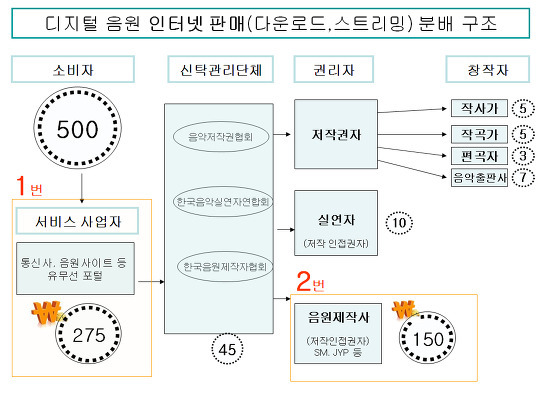
What does the profit distribution structure looks like
for digital music files?


The reports released by Choi Munsoon, the former
congressman show us how things work quite well.


When a consumer downloads a song for 500 won, 55% of
the cost, which is 275 won, goes to the download websites or the service businessmen.
The entertaining companies like SM, JYP get 150 won. 30 won at most go back to
the musician, meaning, only 6 (15)% of the profits go back to the original
creator.


The lives of indie musicians probably are even harsher
than we think.


Early this year, when the indie musician “Dalbit
Yojung Yeukjun Manru Homerun” died of stroke, the impoverished life of the
musician was finally revealed to the public. He sang about his life as a poor
musician and the unfair music profits distribution structure.

                               Mr. Lee Jin-won so called “Dalbit Yojung Yeukjun Manru home-run”


“Acorn shell, can’t even eat it. What the hell am I
supposed to do with it? This song is rubbish, but don’t have me live on morning
dew just because I’m ugly. Let me eat meat at least once a week. Don’t want any
acorns, don’t want any ramyon. Don’t want any squirrels’ food. Give me meat!!”


It seems like musicians, movie directors, writers and
artists have become the pronoun for poverty. However, the poverty they have to
face is not as romantic as the music they create seems to be. It is heart
aching to see that the result of their creation is poverty. Fruit of passion clearly
shouldn’t be this cheap. We need to reflect to ourselves once more where the
values are flowing and if we as consumers are not taking the passion as
granted.


Of course, if we want a change, we have to be the
change!

original Korean version of this post and attached files


by
  • 정보공개센터

정보공개센터는 정부지원 0%, 시민의 후원으로 활동합니다

후원하기
활동소식

Congressmen diplomatic activities, feasts are the important thing not the business!

2011.07.11

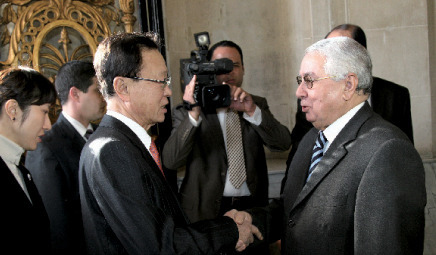
Scene #1.  < 2001누12668 Cancellation of the rejection of petition for opening of information> we conclude cancel that the defendant (the Secretary-General of the National Assembly) have determined reject what petition for opening of information regarding ‘diplomatic activities plan, schedule, plan of execution of the budget and its execution records’ requested by plaintiff in June 12th, 2006.


Scene #2. <March 29th, 2001, Requested information>

Diplomatic activity documents of congressmen visiting foreign nations and attending international forums since the opening of the 18th congress
– documents of diplomatic visit total expenses calculate and its entire documentary evidence(ex, credit card statements, receipts)
– final reports of diplomatic visits

Scene #3. <April 21st, 2011, Disclosure request accepted, after delayed response>
o entire documentary evidence of 18th congress diplomatic visit expenses ⇒
※  couldn’t convert to digital file because there were approximately 10000pages and 1127 cases in total
o final reports of diplomatic visits ⇒ posted on the Secretariat of National Assembly homepage
※  peruse charge 200 won per 10 pages, 100 won per 5 pages if over 10 pages, copy charge 250 won per 1 copy, 50 won per 1 copy if over 1 copy


Translated by SOORIN KIM(voluntarily activist)

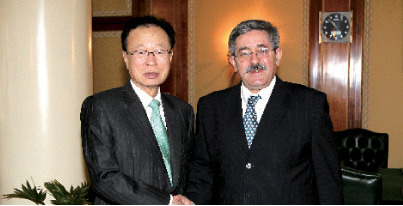
The Supreme Court concluded in 2000 that documents regarding the diplomatic activities of congressmen should be opened to public. So, Center for Freedom of Information and Transparent Society(CFOI) requested the information regarding the diplomatic activities of the 18th congressmen and the Secretariat of the National Assembly. The congress delayed announcement and then decided to open the records. We went to the national archive to check the receipt and accounts. The congress sent the copies by mail but they reversed their decision saying that they cannot disclose the records regarding the Chairmen of Congress. Only after the formal request demanding disclosure of the records to the Secretary General of the National Assembly did the congress decided to open the records.

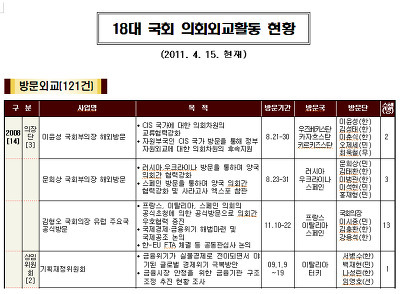
According to the record regarding lists of diplomatic activities since the opening of the 18th congress until last April, cases of foreign visits were 121 and attendance of international meetings was 69. Foreign visits have increased significantly from 14 cases in 2008 to 46 cases in 2009, 43 cases in 2010 and 18 cases in 2011 so far. Attendance of international meeting from 2008 to 2011 so far was 20, 21, 24 and 4 cases respectively.

                       (images: The Secretariat of the National Assembly)

         (A part of congressmen diplomatic activity documents, see attached files)

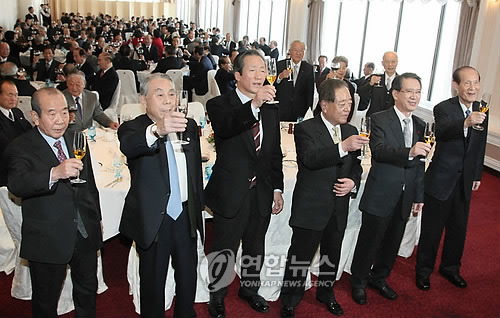
In case of foreign visits, there were cases in which the period staying after completion of purpose was longer than the original schedule. There were also many cases in which the schedule was full of feasts with international corporations or overseas Koreans. Furthermore, several cases of congress diplomacy for friendship were highly doubtful to be regarded as overseas trips.

Details including receipts of expenses used during foreign activities were opened for the public but the disorganized data took a toll on us reading them. Analyzing the information, we can categorize the spending into two main purposes; transportation/accommodation expense and official expense. High percent of the official expenses was used for incentives for embassy officials or throwing feasts for local overseas Koreans and corporation staffs.

Budget for congress diplomacy was 7.7 billion in 2010 and increased to 9.3 billion in 2011. A congressman who is regarded as a minister level according to the public official travel expense rules is provided with 1st class flight, accommodation costs and food expense which is 345~817 dollar a day, and 800 dollar per person or 600 dollar per team for additional expenses.

When the Secretary General of National Assembly goes on to a business trip huge number of officials accompany him and often spend hundreds of millions of budget. Sometimes they schedule events unrelated to the purpose of the visit and spend money to create albums.

Diplomacy is to develop favorable relationship between countries. Making progress through clear purpose and activities is a meaningful thing. The public doesn’t pay tax to provide money for congressmen to tour and enjoy feasts in foreign nations. Proper diplomatic activities and transparent and responsible disclosure are needed.

Lists of congress diplomacy activities and public documents of overseas training of the Secretariat of National Assembly are attached.

original Korean version of this post and attached files


by
  • 정보공개센터

정보공개센터는 정부지원 0%, 시민의 후원으로 활동합니다

후원하기
활동소식

1.2 million won without any work, what a blessing job

2011.07.06


Translated by SOORIN KIM(voluntarily activist)


The minimum hourly wage set by
the law in Korea in 2011 is 4,320 won. After working 8 hours a day, 6 days a
week, and 25 days a month, minimum wage earners are paid only 864,000 won a
month. There are workers that
are not even paid that much. These
temporary employees and shift workers live unstable lives not knowing when they
are going to be fired. They work in fast food restaurants and convenient stores
having hardly any time to take their breath. They only wish to have a chair to
rest on during their meal or break time. 


Meanwhile, some people just take 1.2 million won without
doing anything. They are former congressmen over 65 years old. People have been
questioning this problem of PSROK (The Parliamentarians Society of the Republic
of Korea, Hun Jung Hoi) for quite a long time. However, nothing much has been
done about it. What should have been done is to constantly criticize the
related issues including amendment of the law regarding the pension.


CFOI (Center for Freedom of Information and
Transparent Society) filed several FOIA requests on how much the government
provides in subsidy for the organization. The center demanded ‘lists of former
congressmen receiving the pension and the amount’. The authorities however,
revealed only the total amount paid, claiming that the lists of names were
private information.


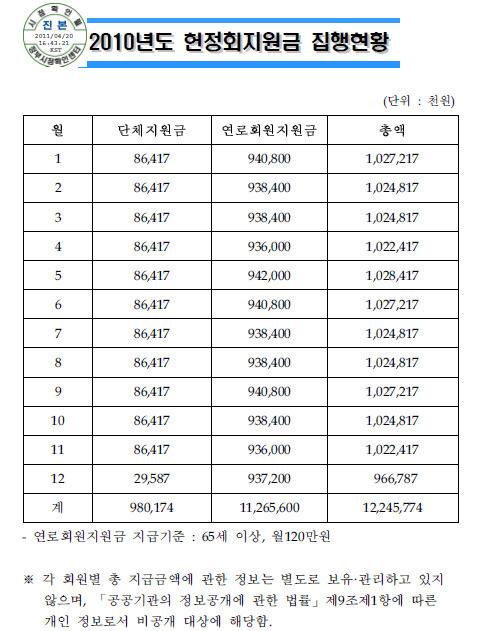
                     – criteria for the pension : over 65 years old, 1.2 million won a month

                   * They don’t have total amounts given to each of the members, and according to Article 9 Clause 1 of   the Freedom of Information Act, such information is classified as private information.


In 2010, the government granted 980 million for the organization
itself, and 11.26 for the members. That means that about 12.2 billion won in
total was used for PSROK a year. It is said that the government will increase
the budget for this organization to 12.5 billion won this year. Isn’t it
reasonable for us to be able to know at least who are getting the 1.2 million a
month pension funded by tax paid by us?


Whether they have millions and billions won, whether
they had committed corruption during their terms, whether they served only one
year all don’t matter. These retired congressmen enjoy their huge privilege
just because they were ex-congressmen.


The terribly
indulgent laws on the organization allow people to work only one day and get
the privilege. It’s even fine to get convicted of committing crime, as long as
they pay back their sentences. They get 1.2 million won a month whatsoever.
What a god blessing job!


If a person gets about
14.4 million won a year, and keeps getting the pension for 15 years, from 65 to
80, the number becomes 200 million won. Doesn’t the public deserve to know who
get how much from the tax? It’s bitter to think about the workers out there
everyday, fighting against temporary employment, low minimum wage, and terrible
working environment.


original Korean version of this post and attached files


by
  • 정보공개센터

정보공개센터는 정부지원 0%, 시민의 후원으로 활동합니다

후원하기