활동소식

One year after “half-price tuitions”: 50% decrease in the number of students getting loans at University of Seoul

2013.01.04

 Translated by: Jiyoung Shin


  Since the introduction of the “half
tuition policy” at the University of Seoul, the number of students who had taken
out loans for the tuition has decreased by more than half. According to the
data provided by Korea Students Aid Foundation (KOSAF), 990.1 students per one
semester had to get student loans for their tuition fees between 2007 and 2011.
However, this number decreased into 473 in 2012.


  Considering
the student population, this equals to 11% of the entire students in 2007.
However, this decreased into 4% in the 2012 Fall semester. This was possible as
the Seoul Mayor Park Won-Soon fulfilled his promise of “half price
tuitions” since his inauguration.


  Of
course, it is not possible to say that this number is absolute. There will be
some students who get loans from institutions other than KOSAF and some others
who get private scholarships. But still, it is obvious that this figure has a
significant meaning.


  Even
before the reduction, the tuition fee of the University of Seoul was lower
than other private universities. Its’ student population is also smaller than
other private universities. If the number of students who applied for loans at the University
of Seoul was 990 on average, the number at other private
universities will be much higher.


  Meanwhile,
the Center for Freedom of Information (CFOI) requested the Ministry of
Education, Science and Technology the information concerning the overdue status
of government-guaranteed student loans between 2010 and 2011. According to the
data provided, the overdue rate was 3.88% in 2011.


  This
is the highest record since the government-guaranteed loans was introduced to
students. The number of overdue cases was 74,150 in December 2011 and the
overdue amount was 229.7 billion. According to the data of Statistics Korea,
the number of students who got loans from KOSAF increased by 162%, which jumped
from 280,000 to 733,000 between 2002 and 2011.
 (http://www.opengirok.or.kr/3076)


  It
is very unfortunate to see this happen to students. We hope the politicians can
cut down the tuition fees for students as soon as possible and the students are
no longer burdened with debts from young ages. You can find the related
information below.


서울시립대대출자수(장학재단)_(1).pdf


by
  • 정보공개센터

정보공개센터는 정부지원 0%, 시민의 후원으로 활동합니다

후원하기
활동소식

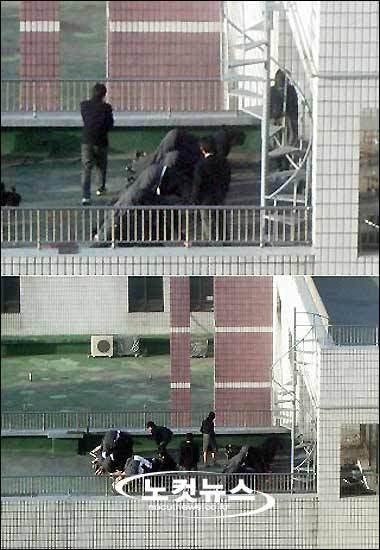
School violence: are counseling and school voluntary work enough to fight it off?

2012.12.28

Translated by SOORIN KIM(voluntarily activist)


Violence in school has been
around for some time, but it is only worsening. In fact, it has become so
widespread that it has its own slang, such as “wangdda” (outcast) and “iljin”
(bully). But students – not just the bullies but also their victims – have
become numb to the problem.


School bullying has become
prevalent to the extent that students consider it a natural part of their
school life. The society has grown used to the occasional news about victims
committing suicide.


People were appalled
recently when a boy in Daegu who had been suffering school violence ended his
own life by jumping off from his 16-floor apartment. They were stunned again
when it was reported that some of the bullies went so far as to rob the store
run by the victim’s parents. The shock however, did not last.


President Lee Myng-bak and
Education Minister Lee Ju-ho met with parents, students and school authorities
to discuss eradicating school violence. Were such a meeting enough to stop
school violence, the tragedy would not have happened in the first place. So we
ask, how has the government been dealing with this aggravating problem of
bullying?


We requested the Education ministry’s accounts of the current situation
concerning school 

violence and handling of it.


1. Actions by the Autonomous School Committee
Against Bullying.


cases of review

number of assailant

number of victim

2009

elementary

school

151

325

273

middle

school

3846

10627

9030

high

school

2608

3653

2405

2010

elementary

school

231

657

294

middle

school

5376

14179

10363

high

school

2216

5113

3091


The number of cases of bullying in primary, middle and
high schools increased by about 18 percent from 6,605 in 2009 to 7,823 in 2010.
 The committee punished the assailants
mostly with penalties, such as cleaning the school restrooms. It also required
them to go through a special educational program designed to prevent school
violence. The victims were provided with counseling.


2.  Types of violence reported by the committee


<year 2009>

Category

Review

cases

Number of incidents

Number of assailants imposed penalty by the committee

injury

240

366

339

physical violence

3,509

9,240

8523

illegal confinement

2

16

14

blackmail

125

274

260

extortion

20

41

38

slander/libel

52

116

113

fraud

10

13

13

sexual assault

110

190

180

bullying

149

689

663

internet obscenity

26

57

56

mugging

1,157

3,044

2981

others

205

559

538

total

5,605

14,605

14276


The most common type of school bullying handled by the
committee was physical assault, followed by mugging. According to the reports
on school violence by the committee, of the 5,605 incidents in 2009, physical
assault took the first place, followed by mugging. The committee said that
there were almost twice as many incidents by boys than by girls. The committee
said there were 4,683 more male bullies, compared with girls. They were mostly
dealt with class changes, special educations, suspensions, and etc.


Category

Review

cases

Number of incidents

Number of assailants imposed penalty by the committee

injury

305

536

515

physical violence

5,119

12,650

12395

illegal confinement

7

15

14

blackmail

177

467

445

extortion

21

40

40

slander/libel

104

274

270

fraud

15

19

19

sexual assault

148

322

319

bullying

206

1001

984

internet obscenity

39

102

101

mugging

1,367

3,404

3365

others

315

1,119

1086

total

7,823

19,949

19,553


In 2010, of the total reported incidents of 7,823,
physical assault again took the first place by 5,119 incidents, with mugging on
the second place by 1,367. Again, assaults by boys (14,740) outnumbered those
by girls (6,209) by about 7,000 incidents. The total reported bullies rose by
about 5,000 compared to last year’s number.


Many cases of school bullying go unreported. Although everybody
is shouting for eradication of bullying and school violence, nobody seems to
have found solutions. Are counseling and changing classes or schools for the
bullies enough for protecting the students? Will disciplinary measures, such as
community work, lead the assailant students onto a right path?


The assaulted students choose death because they think
they have no other way to end the violence, and the assaulters continue their
violence because they are numb to it. Punishing the assailants and protecting
the victims are only measures after the violence already have taken place. We
have to pay attention to the students’ states of mind and relationships, talk
with them and take actions before someone actually gets hurt.


The ministry of education says that it will record the
school violence in school life reports. This however, is controversial, as
there are concerns that this measure might lead to individual students’ bruise
merging once again with college entrance competition or the issue being
attributed solely to the students. We have to think once again, whether this
measure would help us focus on students’ relationships and communications or
rather trigger more segmentations and conflicts.


by
  • 정보공개센터

정보공개센터는 정부지원 0%, 시민의 후원으로 활동합니다

후원하기
활동소식

Minister of Ministry for Special Affairs spent 877 million won under the name of special affairs expenses without any receipt

2012.12.28

Translated by SOORIN KIM(voluntarily activist)


The Ministry for Special Affairs is a ministry created after the establishment of Lee Myung Park Administration.
Currently, Mr. Lee Jae Oh is in charge of the ministry office.


National Assembly Budget Office analyzed the
closing accounts on the major businesses of Office of Ministry for Special
Affairs in 2010. There seems to be some problems regarding spending of the
special affairs expenses.


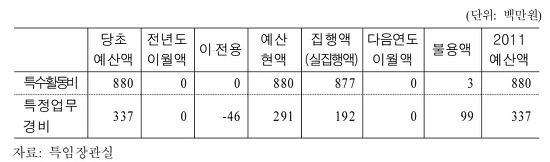
There are two kinds of budget for special affairs in
the Ministry, expenses for special activities and expenses for special tasks.
The former is arranged directly for gathering information and investigation,
etc. The latter is arranged for the specific tasks like inspecting the organs
of government. According to the closing accounts we obtained, the special
activity expenses allocated for Office of Ministry for Special Affairs was 880
million; 870 million won was actually used and 3 million won was not used in
2010. 337 million won was originally for the special tasks expenses, 46 million
was diverted for other purposes, 192 million was used and 99 million was not
used.


2010 Ministry for Special Affairs closing accounts


The problem here was that the Office of
Ministry for Special Affairs did not present any documents to prove the money
was spent properly. The distribution of the special tasks expenses seems
inadequate as well.


Even more striking is 880million won, the
whole allocated money for the special activities was used by only one person,
Mr. Lee Ja Oh, the Minister. The method of distributing the money was need-base
by cash whenever Mr. Lee needed it and after being paid, he wrote a receipt
which only contains his name and amount.
 
So it’s impossible to know where the money went and for what purpose the
money spent. Imagine 877 million won being able to be used without a single piece
of proper receipt. This kind of budget execution is a serious problem in the
transparency aspect.


Furthermore, we found that the Office of
Ministry for Special Affairs had given a portion of the special tasks expenses
to certain individuals by fixed monthly payment. According to the Office of
Ministry for Special Affair’s explanation, total 41 staffs were on the payroll
of the expenses. These people were the whole staff members except for the political
post and the technical post. However, they were not identified as eligible
recipients of the money by any valid basis.


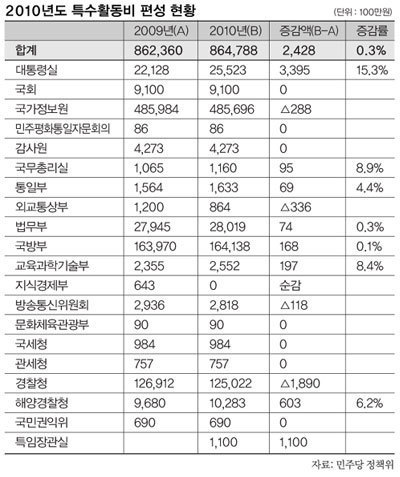
According to a report published by the
Democratic Party, the total budget for special affairs expenses arranged for
each ministry for fiscal year 2010 was about 865 billion won.


Special affairs expenses are called “don’t
ask budget”. No surprise at all. One can easily use the money without any
receipt. How can anybody check where the money goes? Citizens want to know. The
government needs to start putting efforts on building trust from the public and
to reinforce transparency.

by
  • 정보공개센터

정보공개센터는 정부지원 0%, 시민의 후원으로 활동합니다

후원하기
활동소식

Seafood Stew, the Key Part of the Grand National Party’s Political Activities?!

2012.12.26


Translated by SOORIN KIM(voluntarily activist)


The Political funds, obviously, shall only be used for
political activities, not
for personal expenses or wrongful purposes.
However, the money has long been misused such as being treated as ‘pocket money’
for politicians. The CFOI (Center for Freedom of Information), last year,
disclosed some dubious gas charge expenditures by analyzing congressmen Chung Byung
Gug’s political funds spending. And then we suggested that you too use the Freedom
of Information System to keep an eye on your own local congressmen.


CFOI requested the revenue and expenditure reports of
political funds for the Grand National Party (GNP) and the Democratic Party. The
National Election Commission (NEC) released the data to CFOI, and we especially
analyzed the expenses for ‘organization activities’ with spreadsheet. Today, we
would like to share the details of the GNP’s ‘organization activity’ spending.
The GNP’s activity expenses were over 10 billion won a year. Looking into the data,
we could find some interesting parts. 


One of the several interesting things CFOI found out
was that the staff members of the GNP HQ had spend huge amount of money at ‘Sokcho
Seafood Stew’ restaurant. Searching through the data set with the key word
‘Sokcho Seafood Stew’, CFOI even found one expenditure that was over 8 million
won at the restaurant. CFOI found out that they spent over 99 million won under
the name of ‘Sokcho Seafood Stew’ in 2010. We find it very odd for a party to
spend such an enormous amount of money at a single restaurant. 


yr-m-d


usage


receiver


amount


2010-01-12


Party executive food expenses


Sokcho Seafood etc.


8,280,000


2010-02-11


Party executives food expenses


Sokcho Seafood etc.


8,004,000


2010-03-15


Party executives food expenses


Sokcho Seafood etc.


7,857,000


2010-04-09


Party executives food expenses


Sokcho Seafood etc.


9,402,000


2010-05-13


Party executives food expenses


Sokcho Seafood etc.


8,760,000


2010-05-26


Spokesperson food expenses


Sokcho Seafood etc.


210,000


2010-06-02


Secretary general food expenses


Sokcho Seafood etc.


257,000


2010-06-02


Spokesperson food expenses


Sokcho Seafood etc.


39,000


2010-06-09


Party executives food expenses


Sokcho Seafood etc.


8,880,000


2010/7/9


Party executives food expenses


Sokcho Seafood etc.


7,473,000


2010/8/5


Party executives food expenses


Sokcho


8,079,000


2010/9/7


Party executives food expenses


Sokcho Seafood etc.


7,293,000


2010/10/8


Party executives food expenses


Sokcho Seafood etc.


7,014,000


2010/10/27


Party headquarter food expenses


Sokcho Seafood etc.


1,500,000


2010/11/5


Party executives food expenses


Sokcho Seafood etc.


8,166,000


2010/11/9


Spokesperson food expenses


Sokcho Seafood


100,000


2010/12/13


Party executives food expenses


Sokcho Seafood etc.


8,100,000


Another thing was the operation expense from majority
leader’s office. About 800,000 won was mysteriously spent at a movie theater,
CGV.


2010-02-07


Headquarters operating expenses


CGV Yeongdeungpo 


574,000


2010-02-07


Headquarters operating expenses


CGV Yeongdeungpo


245,000


Not only that, CFOI found out that the office
of GNP’s secretary general had bought office equipment at a luxury department
store. Since the items they purchased were not specified, we don’t know exactly
what they bought from the department but it makes us wonder if they really had
to buy room equipment at a luxury store. Apart from these, it indeed was weird
and even fishy that the party had spent too much money on dining in expensive
hotels andtoo much money making placards or New Year’s Cards.


2010-02-05


Security Generals office material

Shinsegae Dept. Store


1,500,000


Of course, they can enjoy feasts at hotels, watch
movies, or spend enormous amounts of money hanging out with their supporters or
party officials, but with their own money, not political funds from citizens.
But we just wish that politicians would spend more prudently the money
contributed by the citizens for better politics.


 original version of this post


by
  • 정보공개센터

정보공개센터는 정부지원 0%, 시민의 후원으로 활동합니다

후원하기
활동소식

‘Reserves for Public Services’ of the Ministry of Culture, Sports and Tourism in 2010: 62.4 billion won! But for what…?

2012.12.18

Translated by SOORIN KIM(voluntarily activist)


There is a public fund called ‘Reserve for Public Services’. It is a budget allocated by MCST (Ministry of Culture, Sports, and Tourism) for public services. 10% of ‘Sports Toto’ lottery business profit and 2.5% of cycle & motorboat racing business profit are the sources of this fund. The thing is that the budget execution of Reserve for Public Services’ has been known as the typical case of public budget waste.


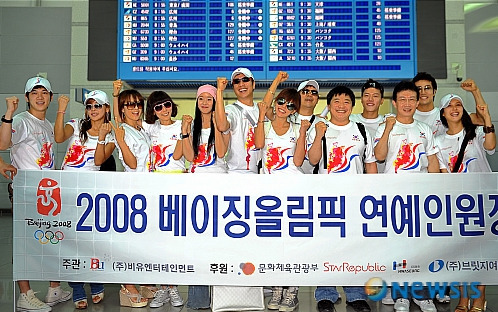
The oversea traveling expenses for the cheering squad of entertainers for Beijing Olympic Game came from the fund. It was very controversial issue several years ago. Not only this, there were many cases in which the reserve was used in inappropriate ways. For example, it was used as a kind of an official expenditure, which MCST gave away to national team athletes or the coaches as incentives. ‘Reserve for Public Service’ is a budget strictly limited to cultures, sports and arts uses for supporting talented people, training experts, educating the disabled, elderly or the low income, and mending and buying facilities for education and training.


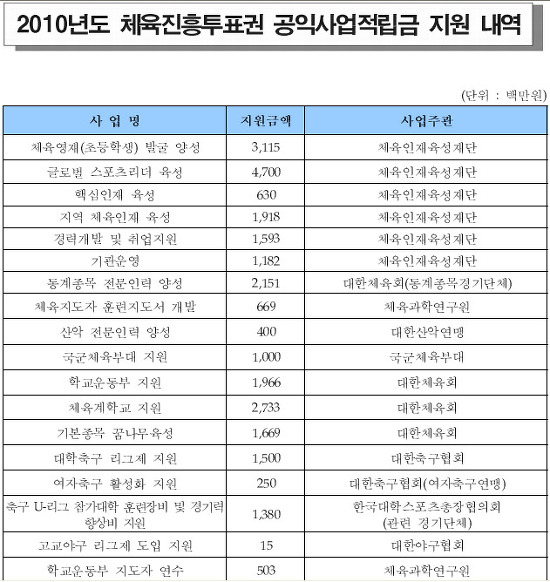
So, CFOI filed FOIA requests for reports on detailed uses of the reserves in 2010. According to the data obtained by the requests, 62.4 billion won of the reserve was funded to 104 projects.


The project that took up most of the budget was ‘the global sports leader promotion project’. 4.7 billion won was given to the project. 2.6 billion won was distributed to 26 Korean consular offices and cultural centers worldwide for ‘global Taekwondo education project’. Yet, the reserves’ subsidy to ‘global Taekwondo project’ is questionable. In 2010, congressman Choi Mun Soon pointed out that 75 million won used for Taekwondo PR by diplomatic offices in the foreign countries was inappropriate expenditures neither for its result nor purposes.


The BAI (the Board of Audit and Inspection of Korea) have pointed out the lax execution of the reserve. In 2009, it received ‘the worst public budget execution award’ from the CAT (Citizens’ Action Network), a renowned NGO. It has been recognized as the notorious waster of public budget by both the government organization and citizen watchdog groups.


The more imminent problem is that the size of the reserves is growing rapidly while it is clear that the money is spent so poorly. In 2006, it was 8.1 billion won, but it had been increased to 30.9 billion won within two years, and in 2010, it reached 62.4 billion won. It is enlarging in a surprising speed.


That the reserves can be spent simply with the minister of the MCST’s approval, and the money isn’t included in the official budget of the ministry makes it seem like some easy money that can be used as the minister’s pocket money. However, there is no hint of reform to fix this problematic practice so far.


When we look into the government budget, it is not hard to find so called ‘easy money’. However, it is not because the money is really ‘easy’. It has become easy money because no matter how many times it is called wasted money or stolen money, the institutions granted with the money never listen to the criticisms.


There is no such thing as ‘easy money’ after all. We all expect the MCST to spend the reserves for public services transparently and appropriately.


by
  • 정보공개센터

정보공개센터는 정부지원 0%, 시민의 후원으로 활동합니다

후원하기
활동소식

Financial Supervisory Service disclosed ridiculous information of spending on working task

2012.08.29

Financial Supervisory Service disclosed ridiculous information of spending on working task


   Translated by Insun Kim(voluntarily activist)
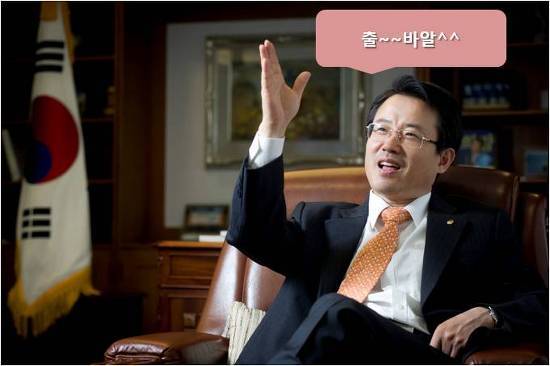


President Kwon Hyeok-sae of the Financial Supervisory Service (picture from  the Financial

Supervisory Service)


Financial Supervisory Service is a special corporation under the Financial Service Commission to supervise financial institutions. As the service center watches financial companies, it is needless to say that the budget statement and administration of the Financial Supervisory Service should be flawless. We, the Center for Freedom of Information, claimed for the budget statement to the corporation, which the president and the vice president spent, since there is no way to find out that kind of data on its website.

What we demanded for

We sincerely thank you for your efforts on your job. These are the list which we would like to know about.

1. Details of expenditure for managing the company, which the president used, from January to June in 2012.

2. Details of expenditure for the extra things, which the president used, from January to June in 2012.

3. Details of expenditure for managing the company, which the vice president used, from January to June in 2012.

ps. The data should include the purpose, place, date, and amount of expenditure.

What the center disclosed to us.

1. Details of expenditure for managing the company, which the president used, from January to June in 2012.

2. Details of expenditure for managing the company, which the vice president used, from January to June in 2012.

We, the Financial Supervisory Service, do not deal with the money for the extra things.


  As you can see above, we asked them to cover the place, date and amount of spending.  However, there was much empty space on the data despite the fact that they opened this information after ten days later.
  What the Financial Supervisory Service revealed on the data was just the sum of expenditure and the frequency of spending per month from between January and June and it was ‘very simple’.


Detailed statement of fund for company operation during the fist half of 2012   (unit : 1000won)

month

conference for processing policy

company event

total

frequency

amount

frequency

amount

January

14

3,861

19

1,900

5.761

February

16

4,343

17

1,700

6,043

March

15

4,422

16

1,600

6,022

April

13

3,619

18

1,800

5,419

May

14

3,970

15

1,500

5,470

June

18

4,833

19

1,900

6,733

total

90

25,047

104

10,400

35,447


Spending on company operation, president Kwon Hyeok-sae used, from January to June in 2012, according to the Financial Supervisory Service.


Detailed statement of fund for company operation during the fist half of 2012 of three vice president. (unit : 1000won)

month

conference for processing policy

company event

total

frequency

amount

frequency

amount

January

29

5,763

11

550

6,313

February

24

4,387

1

50

4,437

March

16

4,064

2

100

4,164

April

29

7,249

3

150

7,399

May

44

8,526

0

0

8,526

June

13

2,755

0

0

2,755

total

155

32,744

17

850

33,594


spending on company operation, the vice presidents used, from January to June in 2012, according to the Financial Supervisory Service.

  Given the amount of expenditure, the corporation spent more than 4,000,000 won on conference for processing policy per month for six months. They also spent 1,500,000 for company event per month for the same time. The total amount is more than 35,000,000, which is very large sum of money.


  However, there is no way to find out whether the money was used properly for its purpose and whether it was the suitable amount. It only shows how much they spent money per month on company operation.


  In other words, to examine whether they waste the fund or not, the data should include the information about the purpose, place, and the number of people who used the money.

  There is no doubt that the Financial Supervisory Service knows that these detailed data should be included on what they provided to us. But, it is unacceptable the Financial Supervisory Service dealt with the data so ambiguously.


  One of the reason that information reporting system was settled and statement of money has to be opened previously is the effort to strength the system for watching on the administration. However, if all the institutions, which are supposed to be supervised, open the information vaguely like the Financial Supervisory Service does, the information disclosure system would be meaningless.


  Finance is the core of capitalistic economy. Therefore, it cannot be emphasized enough that the Financial Supervisory Service, which watches on the financial institutions, is highly important. People cannot trust this corporation unless it can  prove its reliability to public.


original version of this post


by
  • 정보공개센터

정보공개센터는 정부지원 0%, 시민의 후원으로 활동합니다

후원하기
활동소식

 MOFAT’s weak information list is still unsolved! Open the information clearly is the first thing to be done to the rational diplomacy

2012.08.06

  Myongji University, Insun Kim


MOFAT’s weak information list is still unsolved! Open the information clearly is the first thing to be done to the rational diplomacy


  We, Center for Freedom of Information, have criticized that the closeness of Ministry of Foreign Affairs and Trade(MOFAT) and their highly serious state of closed-door negotiation in terms of major facts of FTA. There have been an intended deletion and edition of information list as a result of the analysis we did about the information list for five months, 2012,1~ 2012,5. We criticized them for the same reason last January, the unopened information of their work, but there is no possibility that the situation will be solved.

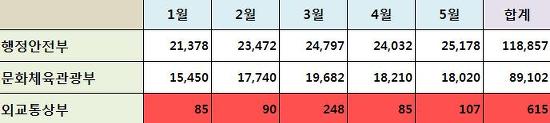
  As the information list of the MOFAT is showing, from January to May of this year, the information which was made by MOFAT or they received from the other ministries  is in an amount of 85 in January, 90 in February, 248 in March, 85 in April, 107 in May and the total number is 615. It means that during the last five months, there have been 123 information which was produced by MOFAT or they received per month on average.


표- Comparison between the MOFAT and the other ministry about the data which was  registered to information list for five months.

  When it comes to the other same administration, Ministry of Public Administration and Security(MOPAS), there have been 118,857 information was produced and received for five months, during the same time, from January to May.

 
  Another case of the other ministry, Ministry of Culture, Sports and Tourism(MCST) produced and received 89,102 data during the same time. Average 17,820 cases were made and received for a month. This represents that MOFAT contains only 1/193 amount of MOPAS’ information and 1/145 of MCST’s one. The question is why MOFAT is rarely working while the other same ministries such as MOFAT and MCST are doing many things? It is hard to accept it commonsensically.

 
  Then, why does this kind of situation happen? It is because MOFAT opens  information to pubic what they want to show by editing themselves. Of course, among the information they provide, reports, diplomatic relations, pushing the treaties or agreements, and the other records about the negotiation are deleted 100%. Therefore, there is no way people know what the MOFAT did last month by searching the list of information they opened.

 
  It is clear that MOFAT is cheating public by opening just a small amount of data. Moreover, we can not completely identify whether all the information the ministry recorded on the list was what they recorded or what they sent to the other ministry or it was executed in within their department or it was received from the other ministry.

  We can not say that such a closed practical of MOFAT is illegal due to the Access to the Public Document law. It is because it is possible to unopen the information as long as it matches with the condition about the closed-door record. However, what MOFAT is doing is excessive.

 
  Do you think that there are so much information which should be closed that MOFAT has to delete and edit by themselves? Moreover, we doubt that the information which should not be revealed to information list is completely meet the ‘can not be opened to public’ condition. It is not the right way administration to unopen the record thoughtlessly regarding the national interest.


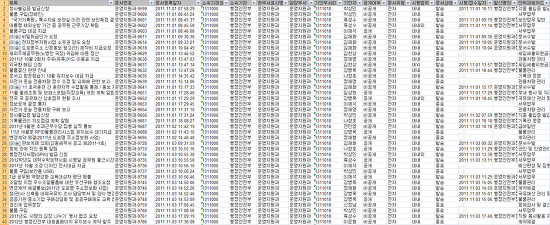
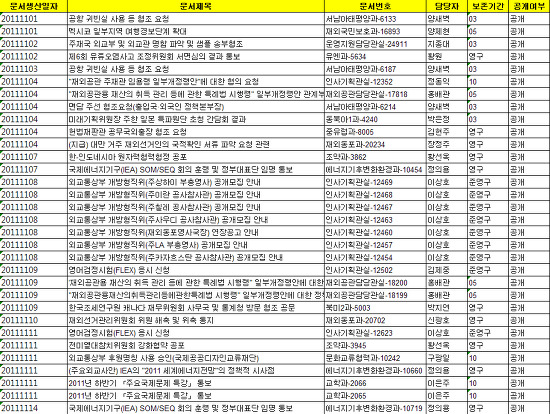
행정안전부의 정보목록(확대-그림클릭)
외교통상부의 정보목록(확대-그림클릭) 


  Recently, Korean society has been disordered because of a military intelligence pact with Japan. And, Foreign Minister Kim Sung-hwan told the context of the agreement and made apology for ignoring public opinion and National assembly during the first 19th assembly meeting of the National Assembly’s Committee for Foreign Affairs, Trade and Unification. It seems that the situation has been settled down tentatively. However, we should keep in mind. We still don’t know any FACT except the prepared report and press conference that MOFAT provides on its own way. This is the dismal reality of Korea in terms of the closing of information.

Original version in Korean


by
  • 정보공개센터

정보공개센터는 정부지원 0%, 시민의 후원으로 활동합니다

후원하기
활동소식

Transparency of Local Government head’s spending, is it okay to leave it as it is now?

2011.08.16


Translated by SOORIN KIM(voluntarily activist)


  The Korean Government Employees’ Union accused on wrongful use 2010 official expenses


   Solution of non-transparency and corruption on official expenses are one of civil society’s long-cherished wishs


The <official’s expense>
of local government heads is a special type of budget that the high ranking officials
can use flexibly on the various situation when expenses are hard to be
reflected in the budget one by one. Thus, the <official’s expense> is
especially a very sensitive type of budget that may draw out many doubts if not
disclosed the details of expenditures to public specifically and transparently.


So, The Center for Freedom
of Information and Transparent Society (CHOI) tried to evaluate how well the
<official’s expense> of local governments were spent or dealt with
transparency.


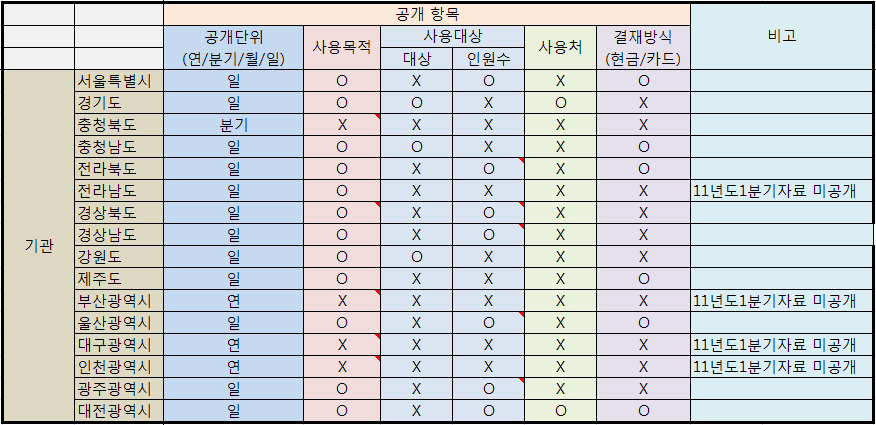
First of all, we classified
the information concerning the <official’s expense> that need to be
opened into 6 items; period, purposes, beneficiary of the expense and number of
people, place the payment was taken place, method of payment (cash, credit
card, etc.). Then we have closely studied each record on the local government
head’s <official’s expense> released by 16 major local governments of
South Korea to see whether the 6 essential items were included in the records.
Finally, we have drawn a table showing each government’s degree of transparency
regarding the <official’s expense>. The result is below;


    *this table reflected official expenses condition data of local government till 7th, june, 2011. 

The transparencies of each of the local governments vary greatly. This is because each local government makes its own lists of public information on official expenses due to non-existence of one form to show official expenses.


If you look at the table, you
can notice that almost all local governments missed at least one out of six
essential items that need to be specified. Also, the quantity and quality of
the information on the <official’s expense> released by each local
governments vary remarkably.


Among 16 local governments,
those that had most serious problems with the <official’s expense> are Incheon,
Busan, Daegu and Chungcheongbuk-do. The mayors and governor of these local
governments did not include any of 6 essential items mentioned above. These four
governments only disclosed total amount of the money spent and vague purposes
of execution so we couldn’t know the details at all. In case of Gyeongsangbuk-do,
because the purposes of the payment were written with extreme ambiguity such as
‘conferences’ or ‘meals’, the exact purposes couldn’t be identified.


On the contrary, Daejeon
and Gyeonggi-do opened the details of there <official’s expenses> reports
transparently. Daejeon metropolitan city identified the purposes of payments
relatively specifically and clearly while Gyeonggi-do province had detailed
records of where and how the officials used the money. There were very few
local autonomous entities that actually disclosed the exact purpose of the
expenses, the beneficiary and the number of them. Only Daejeon and Gyeonggi-do
opened the information.


Evaluating the transparency
of the <official’s expenses> of 16 local entities, we were overall very
disappointed. Until the governmental budget executions like the <official’s
expenses> get transparent, CFOI will never loosen surveillance and
criticism.

original Korean version of this post and attached files

by
  • 정보공개센터

정보공개센터는 정부지원 0%, 시민의 후원으로 활동합니다

후원하기
활동소식

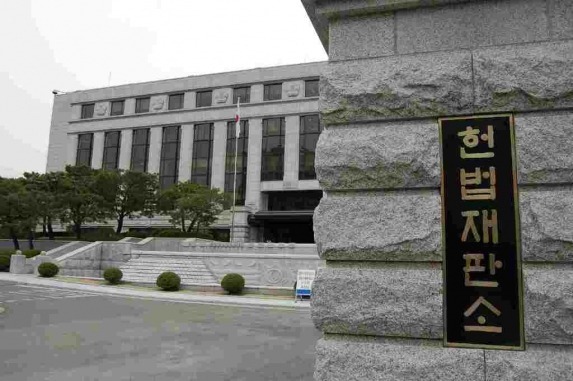
Sleeping Constitutional Court, silent about constitutional appeal five years ago?!

2011.07.27


Translated by SOORIN KIM(voluntarily activist)


In 2009, the Center for Freedom of
Information and Transparent Society (CFOI) filed a constitutional appeal to the
Constitutional Court of Korea. After that, seasons wheeled around and 3 years
have passed but the Constitutional Court is still keeping its silence.


Why did CFOI file a constitutional appeal?
In 2009, we filed a FOIA request to the National Archives of Korea for the lists
of documents newly being disclosed. Few days later the Archives replied to our
request and said that they would release the lists, but with a charge of 5.4
million won. The 270 hard copies is indeed quite a lot, but in electronic
forms, they only consist of 97 files. Does it really cost 5.4 million won just
to organize the data into digital files and e-mail them? We came to think that the
clause of the Official Information Disclosure Act ruling the process of
charging fee on the copies significantly threats people’s right to know. So we filed
a constitutional appeal to the Constitutional Court to make a judgment on
whether the immoderate charge of fee might violate the Constitution of Korea.
But the Court
   hasn’t made any decision
for more than 3 years.


So, CFOI filed a FOIA request to the Constitutional Court for the information regarding the current condition of processing the constitutional appeals from 2005 to the 1st of June 2011. According to the released records of the Court, the number of constitutional appeals registered for the six years and five months is 8,442. Among these, those still on trial are 646 cases.


2008.04.01

2008 no.302

Check the
constitutionality of the Public Official Election Law Article 60 Chapter 3
Clause 2

2008.04.29

submitted

On trial

2008.02.29

2008 no.214

Check the constitutionality
of the Constitutional Court Act Article 68 Clause 1

2008.03.11

submitted

On trial

2008.02.25

2008 no.13

Check the constitutionality
of the latter part of Built Environmental Renewal Development Act Article 65
Clause 2

2008.03.18

submitted

On trial

2007.10.24

2007 no.1190

Check the
constitutionality of Private School Act such as Article 20 Clause 2

2007.11.20

submitted

On trial

2007.10.24

2007 no.1189

Check the
constitutionality of Private School Act such as Article 14 Clause 3

2007.11.20

submitted

On trial

2007.09.21

2007 no.1083

Check the
constitutionality of Foreign Laborers Act such as Article 25 Clause 4

2007.10.16

submitted

On trial

2007.09.05

2007 no.1001

Check the
constitutionality of Public Official Election Act such as Article 93 Clause 1

2007.09.18

submitted

On trial

2006.07.05

2006 no.788

Check the
constitutionality of omission of Korea-Japan Treaty regarding Property
Reclamation and Economic Cooperation Article 3

2006.07.25

submitted

On trial


Taking a deeper look as this, we can see some problems here. According to the Provision 38 of the Constitutional Court Law, the Constitutional Court must announce final decision within 180 days since the case is registered. This means that 400 cases are still pending even though the processing due date has expired.


The oldest case sitting on the bench is the constitutional appeal on <the pact regarding the solution of problems with property and claim between ROK and Japan and the economic cooperation between the two nations>. It’s been under trial since the July of 2006 but is still not solved. The Constitutional Court has been neglecting the case for six years, which should have been handled within six months.


  Skimming through the pending cases, we can
find many appeals on the laws enacted for protecting minorities or supporting the
foundation of the nation, such as minimum wage law, election law, the military
service law and private school law. This means that those laws may have some
defects or contents colliding with constitutional right. But the Constitutional
Court hasn’t taken quick action. If even the Constitutional Court is like this,
what are we supposed to do to protect our rights?


Must the teardrops of the people that suffer from the flawed laws become
the kiss to wake the sleeping Constitutional Court?

original Korean version of this post and attached files

by
  • 정보공개센터

정보공개센터는 정부지원 0%, 시민의 후원으로 활동합니다

후원하기
활동소식

Ministry of Public Administration and Security’s biased and double subsidy for non-profit organizations, continue subsidize for ‘inadequate’ rated organization

2011.07.21


Non-profit organizations and NGOs are important social units that focus on specific and professional public services that the government cannot care details of social sector. For this importance, the central government and local governments subsidize the public services that the non-profit organizations do according to the ‘non-profit organization aid law’. Yet, these government subsidies concentrate on certain organizations unfairly and even go to organizations that are assessed ‘inadequate’ during the intermediate project assessment.

“2010 departments settle accounts analysis II” published by the National Assembly Budget Office points out several important problems regarding the Ministry of Public Administration and Security’s non-profit organization aid programs.

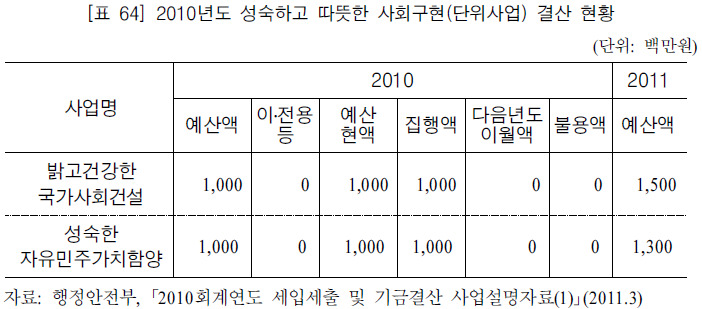
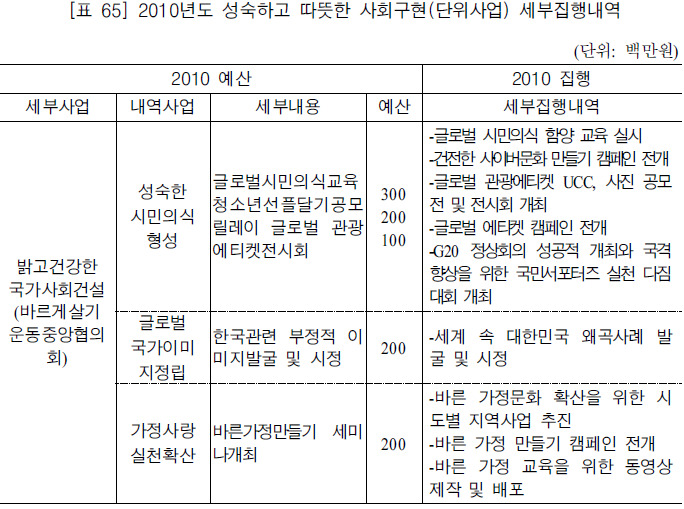
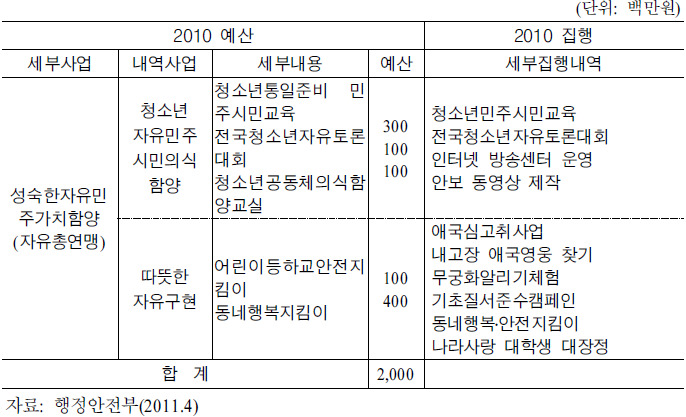
Ministry of Public Administration and Security promoted ‘Bright and Healthy Nation, Society Construction’ and ‘Development of Mature Democratic Values’ as the sub-unit project of the unit project ‘Development of Mature and Warm Society’. These projects aid ‘the Society for a Better Tomorrow’ and ‘Korea Freedom Federation’ respectively. In 2010, 2 billion won was set for ‘Bright and Healthy Nation, Society Construction’ and ‘Development of Mature Democratic Values’. Budget for 2011 increased by 500 million and 300 million won in 2011.

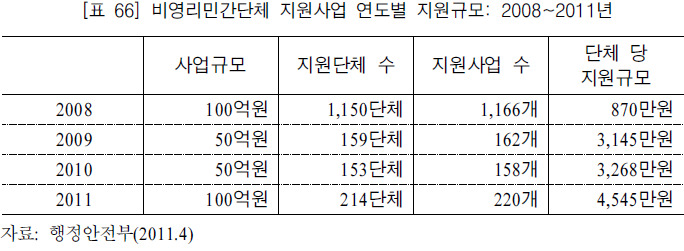
The sub-unit projects above carried out 2 billion won, 1 billion for each. Actually, they are aid for ‘the Society for a Better Tomorrow’ and ‘Korea Freedom Federation’. It turns out that the central government subsidized 1 billion for each organization. In 2010, only 153 of the 9000 organizations got subsidies for their public service projects and the average amount of subsidies is 30 million per organization. Also considering that organizations that don’t get government subsidies are suffering from financial difficulties, this is an unacceptable privilege.

Furthermore, ‘the Society for a Better Tomorrow’ and ‘Korea Freedom Federation’ are organizations that didn’t even go trough proper procedure based on the Non-profit Organization Aid Law to be selected as project player. Moreover, while organizations selected as for subsidy get their aids reduced or exempted according to the project assessment and accounting assessment, ‘the Society for a Better Tomorrow’ and ‘Korea Freedom Federation’ only received simple assessment of accomplishments and capabilities, which are only formal and irrelevant to subsidization. It seems that there exists some huge problems the way of fairness in Ministry of Public Administration and Security viewing public service projects and non-profit organizations.

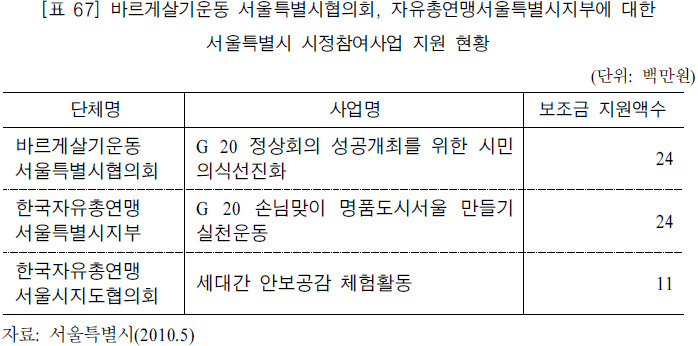
In addition, ‘the Society for a Better Tomorrow’ and ‘Korea Freedom Federation’ get double subsidy also from local governments for the same promotions. The two organizations received subsidy from the Seoul city as well as the central government for promotions related to G 20, getting double aid for single project. Both ‘The Society for a Better Tomorrow’ and ‘Korea Freedom Federation’ have cities and provinces branches.

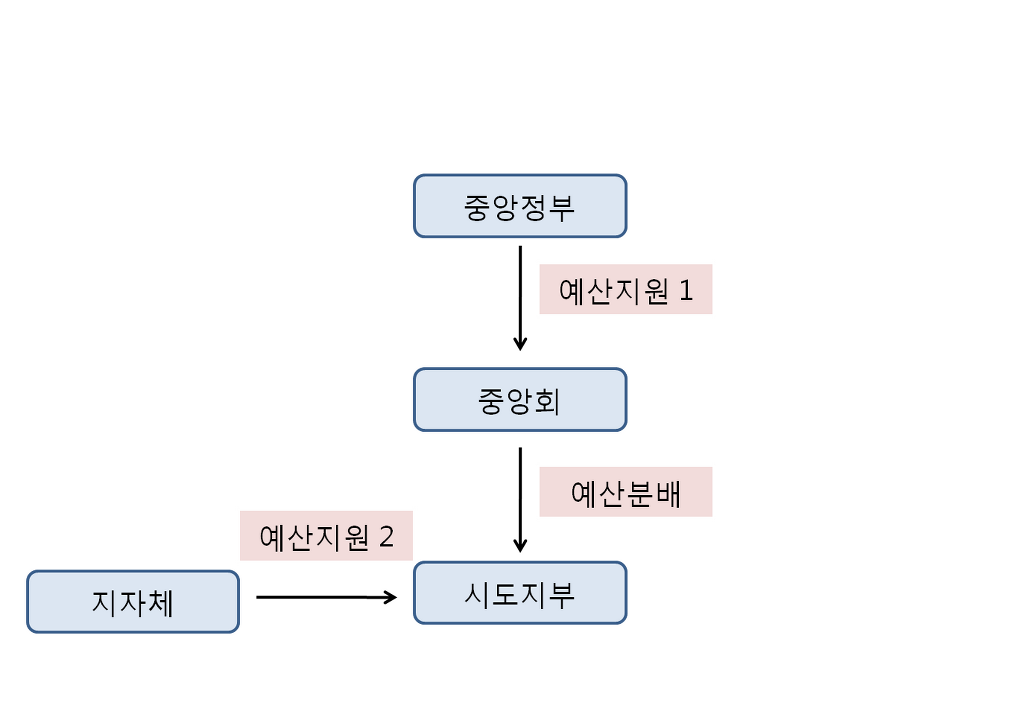
The two carry on the enterprise by the central office making decisions on plans and directions and subsidizing budget to each branches. Nevertheless, the local branches were receiving double aid from local governments.

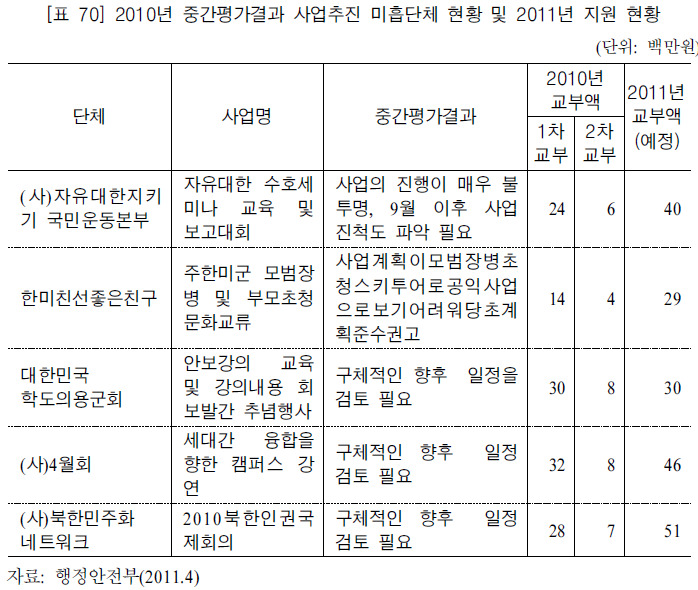
In this way, although ‘the Society for a Better Tomorrow’ and ‘Korea Freedom Federation’ already got aid from the central government for G 20 promotion, the Seoul branch of ‘the Society for a Better Tomorrow’ and Seoul branch of ‘Korea Freedom Federation’ each received additional 24 million for ‘development of civic consciousness for successful G 20 summit’ and ‘making excellent Seoul movement for reception of G 20 guests’. Also, Ministry of Public Administration and Security issued second aid to those organizations assessed ‘inadequate’ by the evaluating committee and increased aid budget compared to last year.

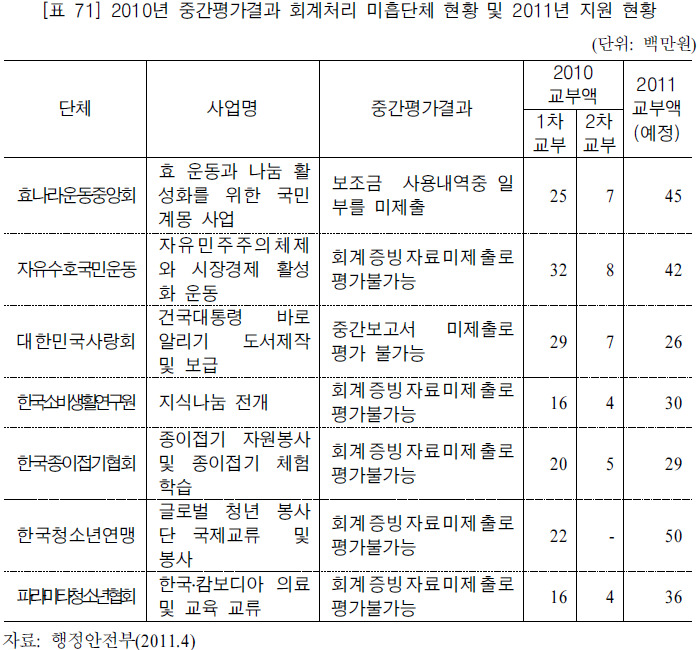
As we can see from the chart above, ‘Save Free Korea Movement Org’, which was analyzed that the progress was vague received 30 million in 2010, and the subsidy even increased to 40 million in 2011. ‘Korea America Good Neighbor Society’ was evaluated that the organization strayed away from the public purposes but received 18 million in 2010 and in 2011 the aid even increased to 29 million won. Other than these, three other organizations and Volunteer Student Army of ROK received subsidy or even increased subsidy in 2011 after their further plans should be evaluated further. Moreover, organizations that omitted some parts of or the whole accounting documents mostly received increased or similar level of subsidy.

Non-profit organizations or NGOs are certainly involved in one of the most important parts of the modern society. That is why it is such a matter of course for those activities to be supported and accepted by the political level. At the same time, it is also a matter of course for those enterprises should be scrutinized and subsidized objectively.

However, like the problems Ministry of Public Administration and Security is showing, there definitely seems to be some serious problems the way they put them into actions. Isn’t this perhaps because the government neglects the original purposes of public goods while ladling out the budget to organizations that fit under their tastes? We must be aware that this is far more serious problem than we think it is right now. This is one facet of corruption that blocks the government from the civil society.


by
  • 정보공개센터

정보공개센터는 정부지원 0%, 시민의 후원으로 활동합니다

후원하기