활동소식

No Improvements At All in Diplomatic Activities of Lawmakers

2013.02.20

There
are some lawmakers that disappointed citizens from the beginning of the New
Year. In addition to passing the appropriation bill after the year is over, the
nine lawmakers of the Special Committee on Budget
and Accounts left for a touristic overseas business trip the very next day.
Although they apologized for their untimely and causeless trip, the problem of
touristic overseas business trips doesn’t seem to get improved at all.

 

<Source:
Naver Encyclopedia / The above image has no relevance with the article>


  In 2011, the Center for Freedom of
Information (CFOI) requested information disclosure about overseas business
trips of lawmakers. Having looked at reports submitted after business trips, the
majority of the reports made it difficult to believe that the schedules they
carried out are related to public duties. Moreover National Assembly Speaker, Park
Hee-tae used 330 million won for his 9 night 11 days trip with tens of
attendants.


  We visited the National Assembly at that time
to see materials such as receipts that can be the proof of the budget spent on
diplomatic activities. However, we had to go through a ridiculous experience
since they suddenly changed their words that documentary evidence of budget
spending on diplomatic activities cannot be disclosed. We could receive the
documentary evidence only after sending an official letter that asks the secretary
general for disclosure. On top of spending tens of millions of won, their trick
to keep secret how the money was used fosters a bigger doubt that they might have
not carried out diplomatic activities properly.


   Two years later, are diplomatic activities of
lawmakers conducted in an appropriate and transparent way? A request for
information disclosure was made with regard to diplomatic activities of lawmakers
between 2011 and 2013. Having looked at the information disclosed by National
Assembly Secretariat,


<2012 Budget on Assembly’s Diplomatic Business>


 Unit: 1 million won


Budget


Spent


Remaining


Assembly
members’ diplomacy
(A)


4,639


3,976


663


– overseas
travel expense


3,396


2,889


– business
operation expense


1,243


1,087


International
Meeting
(B)


1,169


905


– overseas
travel expense


813


718


264


– business operation
expense


356


187


Total (A+B)


5,808


4,881


927


Business
expenses (overseas travel expense + business operation expense) are used
for 
Assembly members’ overseas visits(or attendance at international
meetings), invitation, holding international meetings and exchange programs
with Assembly Secretariat

   It was revealed that 4.8 billion won
out of 5.8 billion won was used in 2012 including diplomatic activities of
Assembly members (overseas travel expense + business operation expense) and
international meetings (overseas travel expense + business operation expense).


  The business expenses include expenses for
overseas visits, invitation and hosting international meetings and exchange
programs with Assembly Secretariat.
They notified that the expense purely used at diplomatic
visits (inc. attendance at international meetings) cannot be disclosed since it
conflicts with their decision of partial disclosure.


  The number of cases for diplomatic activities
(diplomatic visits and attendance at international meetings) of Assembly
members is 61 in 2011, 46 in 2012 and 10 by Jan 24, 2013. 
(The dramatic
decline in diplomatic activities is allegedly due to the general election and
presidential election.)


 <2011-2013
Diplomatic Activities of Assembly members>

(diplomatic visits and attendance at
international meetings)


Unit: 1000 won

2 0 1 1

2 0 1 2

1

92,763

1

54,786

2

48,313

2

30,893

3

Park
Hee-tae

National
Assembly Speaker

3

40,271

4

59,449

4

Park
Hee-tae

National
Assembly Speaker

5

57,995

5

22,943

6

5,359

6

63,090

7

59,581

7

Chung
Ui-hwa

National
Assembly Vice Speaker

8

54,691

8

14,789

9

44,402

9

33,783

10

58,524

10

22,854

11

25,677

11

Chung Ui-hwa

Substituting
National Assembly Speaker

12

75,552

12

8,702

13

56,338

13

65,388

14

60,150

14

18,691

15

Hong
Jae-hyung

National
Assembly Vice Speaker

15

107,699

16

38,416

16

58,704

17

60,928

17

59,968

18

Park
Hee-tae

National
Assembly Speaker

18

48,776

19

76,787

19

35,980

20

26,315

20

27,455

21

57,646

21

13,851

22

127,838

22

24,213

23

Chung
Ui-hwa

 National Assembly Vice Speaker

23

21,010

24

51,591

24

Chung
Ui-hwa

Substituting
National Assembly Speaker

25

33,424

25

36,376

26

18,882

26

48,099

27

107,129

27

52,618

28

16,451

28

Hong Jae-hyung

National
Assembly Vice Speaker

29

61,392

29

35,909

30

60,581

30

67,471

31

55,229

31

80,171

32

57,989

32

55,676

33

55,988

33

47,434

34

Hong Jae-hyung

National
Assembly Vice Speaker

34

Lee
Byung-seok

National
Assembly Vice Speaker

35

16,951

35

Lee Byung-seok

National
Assembly Vice Speaker

36

Park Hee-tae

National
Assembly Speaker

36

69,114

37

17,985

37

7,404

38

5,912

38

15,973

39

49,455

39

16,086

40

40,155

40

19,508

41

21,297

41

15,726

42

52,043

42

Kang
Chang-hee

National
Assembly Speaker

43

9,373

43

86,325

44

41,837

44

8,346

45

50,236

45

25,906

46

18,944

46

30,284

47

57,566

Total

1,492,272

48

30,712

49

32,301

2 0 1 3

50

85,483

51

31,334

1

30,789

52

2,712

53

Park Hee-tae

National
Assembly Speaker

2

56,039

54

13,787

3

75,541

55

25,646

4

108,044

56

70,188

5

60,347

57

19,124

6

54,147

58

80,515

7

44,156

59

3,420

8

Lee Byung-seok

National
Assembly Vice Speaker

60

44,785

9

94,935

61

42,113

10

144,426

Total

2,469,254

Total

668,424


The expenses National Assembly Speaker and Vice Speaker used at diplomatic
activities were excluded in the information provided by the Assembly. That’s
why they could not reveal the total amount of spending on Assembly members’
diplomatic visits (incl. attendance at international meetings)


  After we asked the reason of nondisclosure, they answered that the cases
of Prime Mister’s Office and Office of the President were used as reference.
They added that this issue is related to “national security, national defense,
unification and foreign affairs”, which are subjects of nondisclosure according
to Information Disclosure Act, and it has potential to harm national interests when
disclosed.


   We
asked again why they disclosed the information two years ago and why the issues
related to national security and foreign affairs are not applicable to other Assembly
members. The person in charge at
National Assembly Secretariat
answered that
seemingly it was judged by the top that Assembly Speaker and Vice Speaker
have more important schedules in diplomatic activities and now the situation is
different with two years ago.
Did
foreign affairs and national security suddenly become more important than 2
years ago? And how can national interests become harmed by disclosing the
budget?


  The entire budget used at 54 cases of diplomatic
activities excluding the ones of Assembly Speaker and Vice Speaker from total
61 cases was approximately 2.47 billion won in 2011. In 2012, it was 1.49 billion
won for 38 of 46 cases that was disclosed. By January 2013, the budget was 660
million for 9 of 10 cases that were disclosed. However, it is difficult to
estimate the budget spent on overseas visits of Assembly Speaker and Vice
Speaker since the budget on pure diplomatic visits and attendance at
international meetings (excl. invitation, hosting international meetings and
exchange programs with National Assembly Secretariat) are not disclosed.
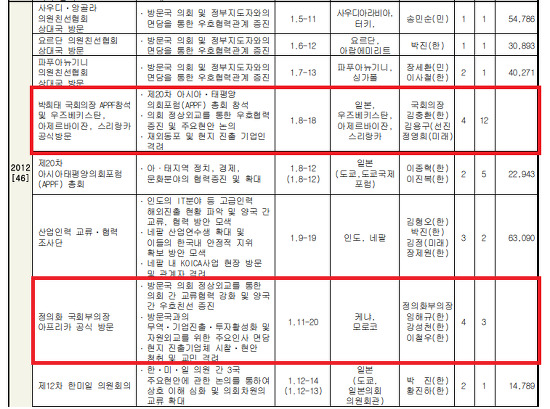


<You can zoom in by clicking the image / Diplomatic
activities of Assembly members, please refer to the attached file for details.>


  How did Assembly Speaker and Vice Speaker use
the budget that they had to use this type of trick? The Assembly that does not
disclose the information since we posed a problem on former National Assembly
Speaker Park Hee-tae’s 9 night 11 days trip to France with his usage of more
than 300 million won, they do not show any improvements despite of severe public
criticism.


  The position of Assembly members is commonly
called as a permanently risk free job and a job of the Gods with all the privileges.
Their privileges and power are given by citizens and therefore eventually those
should be given back to the citizens. The Assembly, one of the most influential
institutions in the nation, is not being
transparent
and its members are abusing their power. The Assembly members are still going
to touristic overseas business trips and the Assembly is not transparently disclosing
the relevant budget. A formal objection was currently submitted to National
Assembly Secretariat in order to receive documents about the budget spent on diplomatic
activities of Assembly Speaker and Vice Speakers. We are looking forward to
receiving the answer from the Assembly.


Related articles:

[한겨레- 정보공개센터 공동기획 ②]국회예산은 쌈짓돈 – 해외시찰의 실체

의원외교활동 , 공무보단 만찬이 중요해!


Attached are the disclosed documents.


2012의회외교사업비(정보공개센터).hwp

의회외교활동_현황(2011-2013)(13-7).pdf


by
  • 정보공개센터

정보공개센터는 정부지원 0%, 시민의 후원으로 활동합니다

후원하기
활동소식

Much-Troubled “Special Business Expenses”, Which Institutions Increased the Budget?

2013.02.19


There is something called Special business expenses which are used by the government. This money is usually provided to
government officials who carry out special tasks such as investigation,
inspection, budget plans and research.


  Recently,
the issue of special business expenses has received spotlight through the
Constitutional Court chief justice nominee, Lee Dong-heub
s misappropriation of special business
expenses. Lee used this money, which is public money given to him for special tasks,
for personal purposes by keeping the money in his personal account and
investing it at financial market products. However, he insisted that he just
followed traditional practices and special business expense is used as personal
money in other institutions as well.


<2012-2013 Budget Plan for Special Business Expense>


 (Unit: 1,000,000)


Institution

2010

2011

2012

2013

Variation

Board of Audit and Inspection

3,049

3,496

3,605

3,926

National Policy Agency

424,704

435,989

440,042

443,381

Ministry of Employment and Labor

4,792

4,808

4,664

4,442

Fair Trade Commission

438

463

691

1,032

Korea Customs Service

9,479

9,670

10,302

10,631

Ministry of Education, Science and
Technology

153

170

89

63

National Science & Technology
Commission

0

0

61

62

Ministry of Patriots and Veterans
Affairs

15

15

15

16

National Human Rights Commission of
Korea

215

215

247

248

Prime Ministers Office

608

581

503

482

Anti-Corruption & Civil Rights Commission

294

381

393

395

Ministry of National Defense

7,705

7,928

11,046

10,802

National Tax Service

46,187

49,767

50,160

47,917

Ministry of Land, Transport and
Maritime Affairs

224

224

210

250

National Assembly

11,224

12,396

17,743

17,875

Financial Services Commission

106

106

106

108

Korea Metrological Administration

17

17

18

19

Ministry of Strategy and Finance

858

858

1,009

1,030

Ministry for Food, Agriculture,
Forestry and Fisheries

1,794

1,775

1,601

1,650

Rural Development Administration

20

28

30

34

Supreme Court of Korea

17,456

17,657

18,063

18,170

Office of the President

5,539

5,494

5,814

5,730

Cultural Heritage Administration of
Korea

22

22

22

22

Ministry of Culture, Sports and
Tourism

54

55

80

82

The National Unification Advisory
Council

117

117

119

120

Korea Communications Commission

212

212

257

258

Defense Acquisition Program
Administration

94

94

96

90

Ministry of Justice

30,387

34,096

37,118

40,137

Ministry of Government Legislation

9

9

9

10

Military Manpower Administration

19

19

39

67

Ministry of Health & Welfare

256

42

42

44

Korea Forest Service

332

350

352

340

National Emergency Management Agency

547

560

578

591

Korea Food & Drug Administration

245

270

278

283

Ministry of Gender Equality &
Family

45

224

223

224

Ministry of Foreign Affairs and Trade

14

14

14

15

Nuclear Safety and Security Commission

0

0

11

33

Public Procurement Service

1,001

1,028

1,071

1,085

Small & Medium Business
Administration

19

19

21

22

National Election Commission

857

1,315

1,325

1,385

Ministry of Knowledge and Economy

156

162

162

162

Truth and Reconciliation Commission

277

0

0

0

Statistics Korea

3,120

3,120

3,098

3,049

Ministry of Unification

30

59

44

57

Office of Mister for Special Affairs

342

342

342

313

Korea Intellectual Property Office

82

84

85

99

Korea Coast Guard

29,045

32,123

33,372

33,613

Ministry of Public Administration and
Security

743

855

914

848

Multifunctional Administrative City
Construction Agency

10

10

14

12

Constitutional Court of Korea

1,040

1,040

1,065

1,082

Ministry of Environment

140

133

144

139

  : Increased
less than 100 million / 
 : Increased more than 100 million 

 ▽ : Decreased less than 100 million
 : Decreased more than 100 million


  In
order to understand the current state of special business expenses, the Center
for Freedom of Information (CFOI) requested information disclosure to the
Ministry of Strategy and Finance with regard to each institution
s budget plan of special business expenses between
2010 and 2013.


  The total budget allocated for
special business expenses in 2013 is 652.445 billion won. Sixty-eight percent
of the total budget, which is equivalent to 443.381 billion won, is allocated
to the National Police Agency followed by the National Tax Service, Ministry of
Justice and Korea Coast Guard.


  Among 51 institutions that receive
the money for special tasks, it is 35 institutions that increased their budget compared
to 2012. More than 100 million won was increased on the budget plans of eight institutions
including the National Police Agency (
3.3 billion),
Ministry of Justice (
3 billion), Korea Coast guard (240 million),
National Assembly (
130 million), Korea Customs Service (320 million) and
Fair Trade Commission (
340 million). Remaining 27 institutions
also increased the budget ranging from a low of 1 million to a high of 60
million.


  There
are only 16 institutions that the budget is same or reduced. The National Tax
Service showed the most dramatic decrease in its budget (
2.24 billion)
followed by the Ministry of National Defense (
240 million) and the Ministry of Employment and Labor (220 million). Other than this, the Office
of the President, Statistics Korea, Ministry of Public Administration and
Security, Prime Minister
s Office, Korea Forest Service, Office of
Minister for Special Affairs, Ministry of Environment, Defence Acquisition Program
Administration, Ministry of Education, Science and Technology and Multifunctional
Administrative City Construction Agency decreased their budget for special
business expenses ranging from a low of 2 million to a high of 84 million won.
The Ministry of Knowledge and Economy and Cultural Heritage Administration of
Korea kept their budget same.


<Source: EBS>


  After the incident of Lee
Dong-heub, the Ministry of Strategy and Finance banned prepaying special
business expenses and notified each institution that special business expenses
more than 300,000 won a month should be paid with credit card keeping records the
reason and amount of the payment. However, potential of the
misappropriation of special business
expenses still remains as there is no need to keep records for the cases under
300,000 won.


  A
reform such as keeping receipts and records for every payment made is necessary
to prevent this. Otherwise, special business expenses can always turn into a blinded
tax.


by
  • 정보공개센터

정보공개센터는 정부지원 0%, 시민의 후원으로 활동합니다

후원하기
활동소식

Result of Requesting Information Disclosure to Presidential Transition Team, “No Communication” Style Still Prevails

2013.02.14


The Center for
Freedom of Information (CFOI) requested information disclosure to the 18th
presidential transition team on Jan 10 regarding the status of their
meetings and meeting minutes.


<Information Request>

1. Status of meetings held so far since
the launch of Park’s transition team. (inc. Name of meetings, date, lead
department, attendees, regular/non-regular)

2. Status of meeting minutes written
so far since the launch of Park’s transition team.(inc. Name of meetings, date,
document number, attendees)

3. Number of shorthand records
written so far since the launch of Park’s transition team.

4. List of reports the head of the
transition team briefed to Park (inc. produced date, title, document number
etc.)

5. Plans of recruiting personnel
administering public archive (archivist) in the transition team.


  The aim was to
investigate what the transition team is doing and whether they are placing
proper records on their work since they have kept a closed-door attitude.


  On Jan 29, 20 days
after extending the date due to their heavy workload, the transition team
notified that they will partially disclose the information.


  The transition team
disclosed the information related to 1,2,3 and 5. The information concerning 4,
however, has not been disclosed.


 It was the list of reports
the head of the transition team briefed to Park that was excluded from the disclosure.
They informed that this information is currently on internal inspection and
therefore it cannot be disclosed. It is difficult to understand why it can’t be
disclosed as we only requested them to disclose the list of reports, not the
actual reports.


  What the CFOI
requested was a “list”, which is even unnecessary to request as the law states
that this should be made public through websites in order for the citizens to
have easy access to the information and to understand the works of institutions.
However, the behaviors of the transition team that does not even disclose the
list can be described as ignoring citizens’ right to know.


Following is the information disclosed.


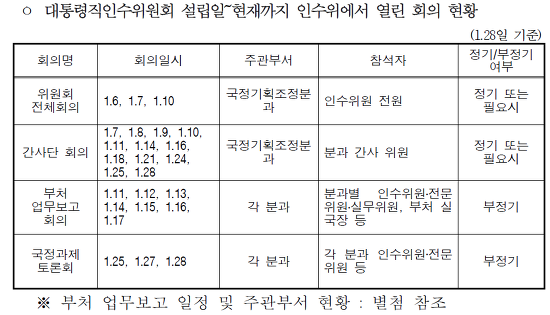
Firstly, the transition team disclosed the status of meetings
held as below.


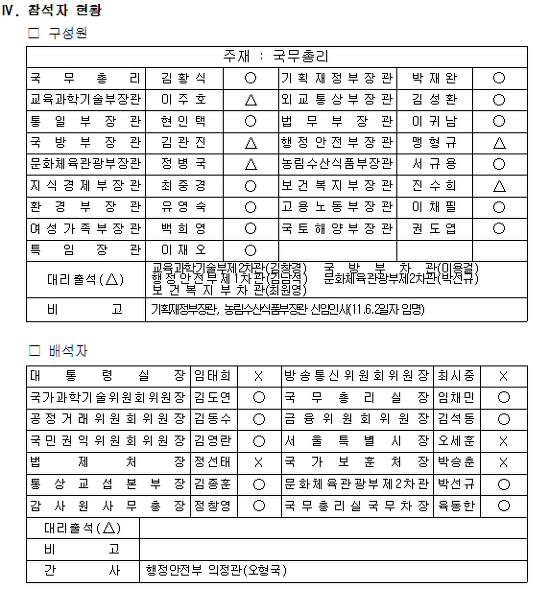
  This does not show
much difference with the schedule that can be found at their website. Maybe it
is even worse than the ones on the website. The list of attendees was also requested
to see who are attending, but it was actually not disclosed. It is impossible
to know who attended the meetings as it only shows positions of attendees.


 According to the Freedom of Information Act, names should be protected as personal information.
But the Act clearly states that the names of individuals the country or local
governments commissioned or requested part of their task shall be disclosed.
Although the names belong to individuals, they should be disclosed since it is
part of public task.


  Nevertheless, the
transition team does not disclose the list of attendees. The person in charge
at the transition team said “We cannot disclose who attended or not attended the
meeting. Who would freely voice their thoughts at the meeting if this
information is disclosed? You will receive similar answers when you ask other
institutions.” But what the CFOI requested is the list of attendees, not the
content of their comments nor the minute itself. Their right to speak can be
restricted by disclosing whether they participated the meeting or not? It is a
closed minded way of thinking. Moreover, the status of attendees is the one
that can always be checked through requesting information disclosure.


  Last year, the CFOI
requested the minutes of Cabinet meeting and they were disclosed. The above
information includes details of the people attended the meeting. The transition
team said others will not disclose the information just like what they did, but
others already have disclosed the information. It is because this is a
common-sense and one of the basics.


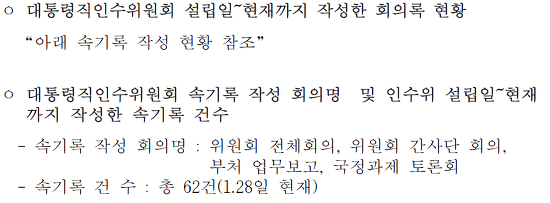
Secondly, we requested the status of meeting minutes and shorthand
records that were written. The transition informed that they have 62 shorthand
records till Jan 28. Shorthand records were used for 3 general meetings, 12 assistant
administrator meetings, 3 debates on major government projects and 44 meetings
reporting activities of departments.


  It is happy to hear
that shorthand records are used more often than meeting minutes. Shorthand
records which write everything at the meeting is more detailed than meeting
minutes that summarize the meeting.


  Then, are these
records properly supervised?


Lastly, the CFOI requested information on the transition team
s plan to recruit archivists in
charge of the records management. According to media reports, there is no
specialist responsible for the records management at the transition team. The
transition team answered that
We deal with
the task related to the records management with an assist from National
Archives of Korea and later we will be supported by archivists if necessary
. In the phone call with the
transition team, the person who answered the phone said he is in charge of the
record management and archivists from National Archives of Korea is planned to
be placed at the stage of clearing the transition team. According to the act of
public archives management, it is mandatory for public institutions to be
staffed with archivists who received a certain level of professional education
for the systematic and professional management of records. This is an essential
factor for the systematic and faultless management of records. But the transition
team is currently without archivists justifying that they are assisted by
National Archives of Korea.


  The information disclosed by the transition team is at an insufficient
level. They over interpreted the clauses on nondisclosure and refused to
disclose the ones that need to be disclosed. The ones they disclosed also have
insufficient content.

  Apart from this case,
the transition team refused to disclose information about activity reports per
department that the CFOI requested. We can understand that some information in the
reports cannot be disclosed, but some others can be surely disclosed without
any problems. Although the transition team needs to disclose as much as possible
at this moment the trust of citizens is on decrease due to their lack of communication,
it seems they remain same.

 
Due to this, the CFOI is planning to request an administrative trial on
February 7 protesting against the transition team that undisclosed/partly
disclosed the information. We will pay attention to the decision of the Central
Administrative Appeals Commission concerning the
no communication of the transition team.


 The president elect, Park, previously pledged
the Government 3.0 to spread information disclosure and share information with
everyone. But her will to communicate with citizens has disappeared. We just want
her to be at least faithful to the Government 1.0, which is the information
disclosure, let alone the Government 3.0.


Attached is the information
disclosed by the transition team.


인수위_공개내용.pdf


by
  • 정보공개센터

정보공개센터는 정부지원 0%, 시민의 후원으로 활동합니다

후원하기
활동소식

Some Members of the 19th National Assembly Haven’t Introduced Any Bills So Far!

2013.02.14


* Correction *

The CFOI previously announced that Lee
Jong-jin hasn’t submitted any representative proposals. However, this turned
out to be a mistake of the person in charge at the CFOI. Also there has been a
mistake in the number of joint proposals. Therefore, some corrections have been
made regarding this. We deeply apologize to Lee Jong-jin for the mistakes.


  What are the most important activities for
the members of the National Assembly?  Legislative activities which make
and amend the laws on behalf of the citizens will be the answer.  Using the Legislative
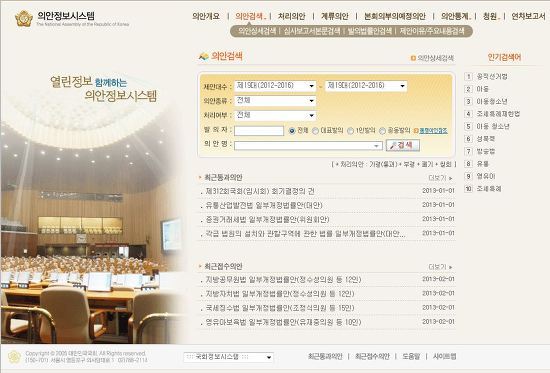
Information System
of the National Assembly, the Center of Freedom of
Information (CFOI) analyzed how active the members of the National Assembly are
in terms of legislative activities.


  To
start with, the number of bills, amendments and resolutions proposed between
May 2012 and Jan 30, 2013 by the 19th National Assembly is 2967. 541
bills were passed or handled among these.


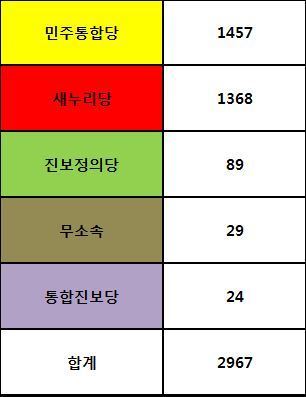
●Number of introducing bills per party
for the 19th National Assembly


  The
Saenuri Party, which has 154 members, proposed 1368 bills and the Democratic
United Party, which has 127 members, proposed 1457 bills. 


The Progressive Justice Party, which has 7 members, proposed 89 bills. 6
independent members proposed 29 bills and the United Progressive Party, which
has 6 members, submitted 24 bills so far.


●Average number of proposed bills per
party for the 19th National Assembly


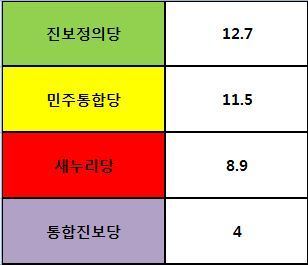
  Simply put, as for the members of
the Saenuri Party, one person proposed 8.9 bills and the members of Democratic
United Party proposed 11.5 bills per one person. The members of the Progressive
Justice Party and the United Progressive Party proposed 12.7 and 4 bills per
one person each. In total, it is possible to say that the entire 300 members of
the National Assembly proposed 9.9 bills per one person so far.


  While
some are active, there are some others who haven’t proposed any bills.


 Name (Party)

 Representative
Proposal

 Joint
Proposal

 Kang Seog-hoon (Saenuri)

 0

 82

 Shim Yoon-joe (Saenuri)

 0

 65

 Lee Un-Ryong (Saenuri)

 0

 38

 Chang Yoon-seok (Saenuri)

 0

 75

 Boo Jwa-hyun (Democratic
United
)

 0

 39

 Lee Seok-ki(United Progressive)

 0

 35


●List of the members of 19th
National Assembly without representative/joint proposal


  Kang
Seog-hoon, Shim yoon-joe and Chang Yoon-seok of the Saenuri Party, Boo Jwahyun
of the Democratic United Party and Lee Seok-ki of the United Progressive Party had
no representative proposals at all. Above six people only participated in lawmaking
activities through joint proposals. Relying on others, they did not manage to
submit their own proposals.


  Of
course, the high number of bills proposed does not automatically mean it is good.
Furthermore, abusively proposing low quality bills as a way of showing tangible
result should be avoided. However, the fact that they haven’t proposed any
bills by themselves as someone who represents the citizens means that they
neglected their duties. Doesn’t this deserve criticism? 


*Lee Un-Ryong (Saenuri Party) became a
member of the National Assembly as of January, as a substitute of the
president-elect, Park Geun-hye.

*The data related to Kang Seog-hoon (Saenuri
Party) was left out due to the data omission which has been revised now.


국회_의안_대표발의_현황.xlsx


by
  • 정보공개센터

정보공개센터는 정부지원 0%, 시민의 후원으로 활동합니다

후원하기
활동소식

Park’s Transition Team: A Sanctuary for Closed Information? List of Information and Names of Public Officials All Kept Secret

2013.02.12


  The “No Communication” move of the Park’s
transition team doesn’t seem to get improved. Park is still insisting her
“do-it-myself” style and the sealed briefing of Yoon chang-jung, the spokesperson
of the transition team, is still content-less. We can easily notice this by
seeing the public criticism against their continuous failure of the personnel
appointment and the “no communication” style.


The
Center for Freedom of Information (CFOI) wanted to check what kind of tasks the
transition team is doing. In order to check this indirectly, we have requested
information disclosure to 46 central government agencies regarding the list of
public documents they received from the transition team. We requested this to
central government agencies since the object of the information disclosure not
only covers the documents produced inside the institution but also the ones
being preserved and administered in the institution after receiving from outside.


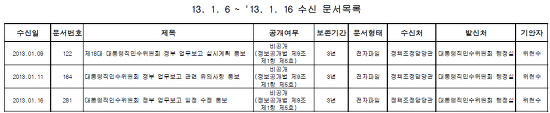
<Information Request>

We request information disclosure regarding the list
of documents received from the transition team for the 18th
president between Jan 6, 2013 and Jan 16, 2013. Please include the received
date, document number, title, disclosure/nondisclosure (reasons), document
type(paper, electronic file), To, From, drafter etc.


Having
seen the result, however, levels of the disclosure was widely different. While
some disclosed all what it was requested, others even kept the list of
documents secret. One of the answers we received stated that the name of the
person responsible for the task is classified as personal information and
therefore it cannot be disclosed. There were also some cases that postponed
disclosing information.


Institution

Answer

Reason (applicable sub-paragraph in 

Article 9 (1) of the Freedom of Information Act

The Board of Audit and
Inspection

Disclosed

Korean Government Personal
Information Protection Commission

Nonexistent

X

Korean National Police
Agency

Disclosed

Ministry of Employment and
Labor

Disclosed

Fair Trade Commission

Disclosed

Korea Customs Service

Disclosed

Ministry of Education,
Science and Technology

Partly Disclosed

6

National Science &
Technology Commission

Partly Disclosed

6

Ministry of Patriots and
Veterans Affairs

Disclosed

Prime Minister’s Office

Disclosed

Anti-Corruption and Civil
Rights Commission of Korea

Disclosed

Ministry of National Defense

Postponed

The briefing on the request
is under process

National Tax Service

Disclosed

Ministry of Land, Transport
and Maritime Affairs

Undisclosed

5

Financial Services
Commission

Disclosed

Korea Meteorological Administration

Disclosed

Ministry of Strategy and Finance

Disclosed

The Ministry for Food, Agriculture, Forestry and
Fisheries

Undisclosed

5

Rural Development Administration

Undisclosed

5

the Supreme Public Prosecutors Office

Transfer

Ministry of Justice

Cultural Heritage Administration

Immediately Disclosed

The Ministry of Culture, Sports and Tourism 

Disclosed

The National Unification
Advisory Council

Immediately Disclosed

X

Korea Communications
Commission

Postponed

Need to hear the opinion of
the public institution which produced the information

Defense Acquisition Program
Administration

Disclosed

Ministry of Justice

Disclosed

Ministry of Government
Legislation

Disclosed

Military Manpower
Administration

Disclosed

Ministry of Health &
Welfare

Partly Disclosed

6

Korea Forest Service

Disclosed

National
Emergency Management Agency

Disclosed

Korea Food & Drug Administration

Undisclosed

5

Ministry of Gender Equality
& Family

Disclosed

Ministry of Foreign Affairs
and Trade

Postponed

More time needed

Nuclear Safety and Security
Commission

Partly Disclosed

Article 5 (1)

Public Records & Archives Management
Law
 20 (1)

Public Procurement Service

Disclosed

Small and Medium Business
Administration

Disclosed

Ministry of Knowledge
Economy

Postponed

An inquiry commission to be
held

Statistics Korea

Disclosed

Ministry of Unification

Disclosed

Office of Minister for
Special Affairs

Partly Disclosed

Korean Intellectual Property
Office

Undisclosed

2, 5

Korea Coast Guard

Disclosed

Ministry of Public Administration and Security

Disclosed

Multifunctional Administrative City Construction Agency

Disclosed

Ministry of Environment

Disclosed


  The Ministry of National Defense, Korea
Communications Commission, the Ministry of Foreign Affairs and the Ministry of
Knowledge Economy postponed deciding whether to disclose or not.
The Supreme Public Prosecutors Office passed the
request to the Ministry of Justice saying that it is not their task.


  It was following five institutions: Ministry
of Land, Transport and Maritime Affairs,
The Ministry for Food,
Agriculture, Forestry and Fisheries, Rural Development Administration,
Korea Food & Drug Administration,
Korean Intellectual Property Office that refused to provide the list of
documents. Originally, the list of documents is one of the information that requesting
for information disclosure is not necessary since it is supposed to be
published on the website. Even this type of basic information was undisclosed.
They are not even complying with the minimum guideline of the information
disclosure.


  Ministry of Education, Science and
Technology, National Science & Technology Commission, Ministry of Health
& Welfare, Nuclear Safety and Security Commission and Office of Minister
for Special Affairs made secret the names of senders who sent the document from
the transition team.  (The Nuclear Safety
and Security Commission undisclosed the data saying that “On-Nara’s Electronic
files of the list does not include names of senders”)

Some
institutions deliberately excluded the names and claimed it as a “full
disclosure”.


  Of course, the names of individuals are the objects of the
nondisclosure. However, this is only applicable when they are pure
individuals. The act on information disclosure
clearly states that the name of the public official responsible for the task
should be disclosed. It is possible to say that they are disregarding the
information disclosure act.


  Even the
central government agencies are covering it up for the transition team and its
relevant information. It seems that the transition team became a sanctuary for
the closed information.


  The
transition team
s lack of
communication is spreading to the central government agencies as well. The
upcoming 5 years look bleak as this might be the picture of the Park
s government.


by
  • 정보공개센터

정보공개센터는 정부지원 0%, 시민의 후원으로 활동합니다

후원하기
활동소식

“Overseas Business and Training Information System” turns out to be Useless?

2013.02.04


By Jang Seong-hyun (voluntary activist)


As if celebrating the first day of 2013, members of the Special Committee
on Budget & Accounts made the citizens frown by leaving for overseas
training after hastily processing the budget plan. You may wonder what is so
serious about the fact that they went for overseas trainings to increase the
expertise of the legislative process. But you will think differently if you see
the purpose of their overseas trainings. In order to learn an advanced system
of budget supervision in person, they went to Africa and Latin America. It
is curious which part of the budget supervision system is so advanced in Africa
and Latin America that they went there even enduring the criticism of citizens.


  As such an issue captured the attention of
citizens from the first day of the New Year, the Center for Freedom of
Information (CFOI) requested information disclosure to some of central governmental
agencies
regarding official
business trips of their public officials as below.


 2011-2012 Overseas business trips of the president and employees of the organization 

1.       Country

2.       Purpose and description of the trip

3.       Please disclose the cases classifying the purpose/total spending/date of accommodation fees, air fare, business expense

4.       Trip Itinerary

5.       Number of people (ex. 000 and XX others)

6.       Business Trip Report


  The answer from all the governmental agencies
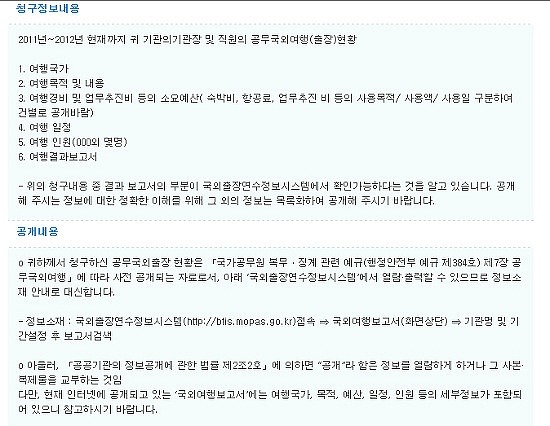
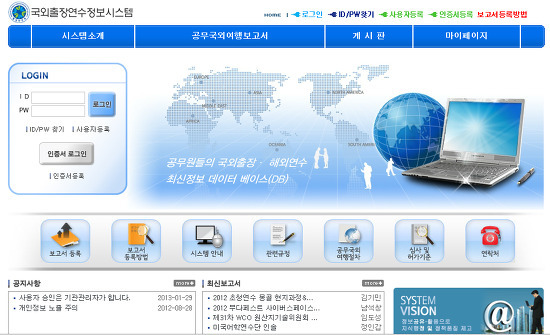
was that the requested information can be found at the
Overseas Business and Training Information
System (http://btis.mopas.go.kr).


   The public officials are required to register
on the system when they are back from their overseas business trips. So it was
their answer that the requested information can be found on the system by
selecting Overseas Business Trip – Search report – Governmental agencies and
Public institutions. We accessed the system as told.


 <Overseas Business and Training Information
System (
http://btis.mopas.go.kr)>


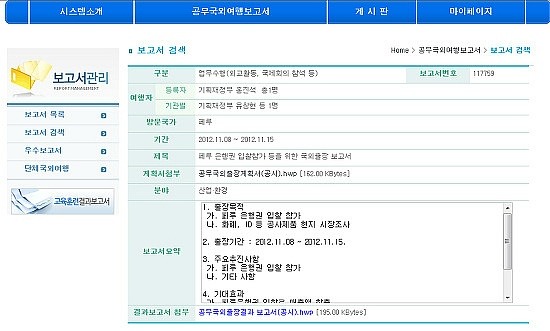
   In many cases, however, among the
requested information, the budget on travelling expenses was not found on
the Overseas Business and Training Information System. The public official in
charge said there is an item related to the budget next to the <Attach Report>,
but we could not find it.


<Overseas Business and Training Information
System (
http://btis.mopas.go.kr)>


The public official in charge
kept insisting that it can be found on the system but it was not visible for us.
Possibly, the budget is only visible to public officials and the information
is not open to the public. This issue requires a clear answer from the
government if they are only disclosing the information to the public officials
and if so, why they are operating the system in such a way.


  To say the conclusion first, the CFOI wasn’t
able to obtain the information related to the budget. The reason is not only about
the non-disclosure (?) of the budget. It is also due to the inconsistency
between the central governmental agencies that were requested to disclose
information and the Ministry of Public Administration and Security that administrates
the Overseas Business and Training Information System. The central governmental
agencies that was requested to disclose information claimed that the relevant information
can be found at the Overseas Business and Training Information System but the
Ministry of the Public Administration and Security said the information
disclosure does not cover budget spending.


   The original information is obviously written
by the public institution in charge. It is difficult to understand that the
Ministry of the Public Administration and Security, who is only in charge of
administrating the system, insists they cannot disclose the information which the
responsible governmental agency is even willing to disclose. The responsible institution
says that they don’t’ need to provide the information additionally since it is
already published on the system. The Ministry of the Public Administration and
Security says they are not required to disclose budget spending on the system
and asks us to receive the information from the central governmental agencies. Then
who is responsible for the information I want to know?


  In addition to the fact the budget is not
open to the public, there were many cases that business trip plans and reports
are poorly written or written several months after returning from training.


 <Regulation on Overseas Business Trips>


5. Submission, registration and post management of the report

Ga. Submission of the Overseas Business Trip Report

(1) The overseas business trip report (referred as “report” from here) needs to be submitted to the Minister within 30 days of the return.

(Ga) The report should specify in detail the main activities, implications and additional remarks consistent with the travelling purpose and result of the Overseas Business Trip Plan<Attached 1>

(2) Important issues related to the foreign affairs should be reported to the Minister of Foreign Affairs and Trade in writing within 14 days of the return


Na. Registration of the report on the information distribution network

(1) Along with the <Attached 2>, the Minister should make the received report registered on the Overseas Business and Training Information System.

(Ga) But in case of the preservation of the national secret and the security, it is possible not to register the report. But in this case, the reason of the non-disclosure should be specified and reported to the Minister of the Public Administration and Security.

(Na) All the data collected from overseas should be registered on the Overseas Business and Training Information System in order to prevent the repetition of data requests. The collected data which are difficult for registering on the system can be registered on the system after briefly organizing the list and description of the data.


Da. Post management and etc.

(1) For the systematic administration of the overseas business trips, the Minister shall appoint the person responsible for submitting, registering reports and other administrative tasks to make inspections and improvements internally regarding the present state of the overseas business trips, registration of reports and its utilization.


 The
regulation on overseas business trips of public officials states that reports should be submitted within 30 days, but there is a case the report was
uploaded after one year.


  Problems also exist in overseas
business trip plans. Obviously it is required to write down the budget on the
plan, but it remains blank for many cases. The CFOI randomly selected information of the Ministry of Justice, the Ministry of Knowledge Economy and
Korea Communications Commission written in 2012 and 2011 and the result showed
that 30 of 64 for the Ministry of Justice, 31 of 95 for the Ministry of Knowledge
Economy and 19 out of 123 for the Korea Communications Commission excluded information related to budget spending on their overseas business trip plans.
Making inspections and improvements through the person in charge, stated by the
regulation, are seemingly not happening.  


  It makes us wonder why the overseas business
and training information system was created if the system is poorly managed like
this way and the proper information cannot be found. On top of the fact that
information is poorly reported, public officials who are in charge seem
to have an insufficient understating of the overseas business and training
information system. It must be a system made to reveal information transparently
regarding business trips and training, but it is only a waste of taxes
when it is neglected this way.


by
  • 정보공개센터

정보공개센터는 정부지원 0%, 시민의 후원으로 활동합니다

후원하기
활동소식

Fostering Social Enterprises Requires Substantial Support

2013.01.28


  The
word “Social Enterprise” is quite familiar to us now. About 10 years ago,
“venture companies” prevailed in Korea. At that time, there was a start-up boom among the youth. Now the boom has been moved to the
social enterprises.


  The
“Social enterprise” refers to the companies that emphasizes corporate
social responsibilities and pursue social purposes in operating business which
slightly differs from the venture companies that operates business in one
sector with expertise. 


Legal
concepts of a social enterprise

Ÿ  
A company which does
business activities of producing and selling products and services while
pursuing such social purposes as providing vulnerable social groups with
social services or jobs to improve the quality of life of the local
residents.

Ÿ  
A company which reinvests
profits in the business or the local community putting priority on pursuing
social purposes rather than on maximizing profits for shareholders or owner
of the company.


  There are some young people around me who are creating new companies as
a social enterprise. Among them, some sells rice balls with the “fighting” message. Some others sell coffee and the space or make recycled wallets and
bags from old clothes or leather sofas.


  In order to solve the problems of the unemployment, the central and local governments are currently promoting some projects that support
social enterprises and young people launching their own business.
 According
to the Social Enterprises Report of the Ministry of Employment and Labor, there
were 699 social enterprises and 1522 preliminary social enterprises in September
2012 which makes 2221 social enterprises in total. The number of the employees
of social enterprises are 17,410 and 10,640 people among them are
vulnerable members of the society.


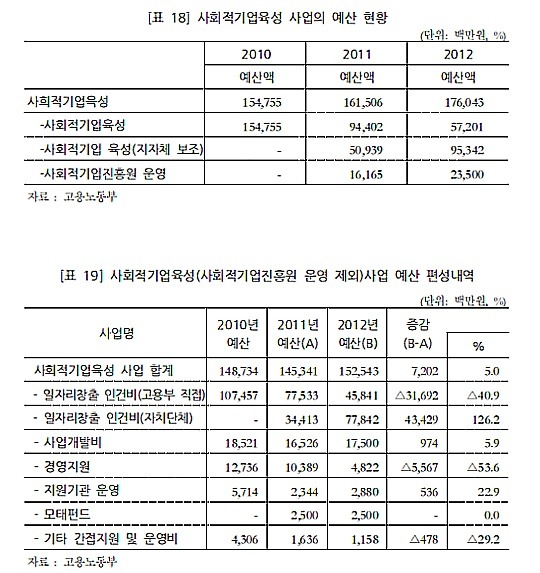
  According
to the same report, the budget is increasing; 154.7 billion won in 2012, 161.5
billion won in 2011 and 176 billion won in 2012. In 2013 the budget has been
set at 162.7 billion won. (The reduction on the budget is due to the decreased
labor cost)


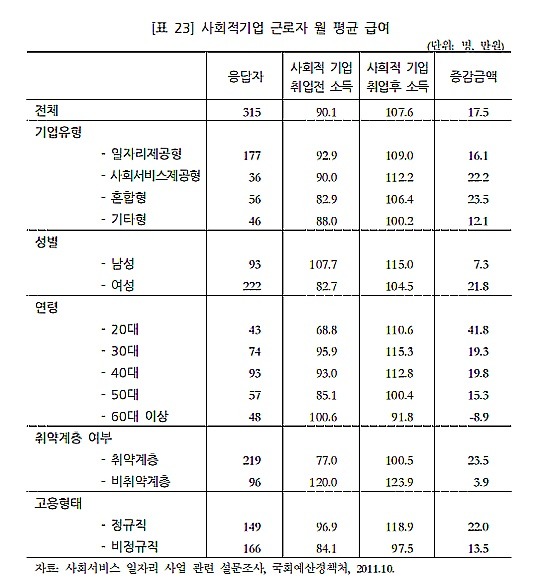
  The
average wage of the employees of the social enterprises can be found as below.
The employees whose wage was 900,000 won before receive 107,000 won after working at social enterprises,
which is up 170,000 won. The groups of
vulnerable people, women and 20s showed a remarkable increase.


[Employment Type of Social Enterprise Employees]

(Unit: %)

Employment type

Employees of Social Enterprises

Total Employees

Vulnerable

Non-vulnerable

Average

Average

Regular

44.7

53.1

47.3

65.8

Temporary

55.3

46.9

52.7

34.2

(The employment type for total employees is from the website of the Ministry of the Employment and
Labor/ The employment type for the employees of social enterprise is from the
result of the survey on 315 social enterprises)


  However, the rate of temporary employees
in social enterprises amounts to 52.7% and they account for 34.2% of the total
employees. Considering the fact that temporary employees form a bigger portion in
the vulnerable group, it is possible to notice that the vulnerable group
receives more income after employment but they are still under a poor
condition in terms of the types of employment.


[2007~2010 Social Enterprises Income Statement]

(Unit: 100 million
won
, %)

2007

2008

2009

2010

Rate of Change

Sales

464.67

1,342.57

2,345.80

3,764.70

59.9

Cost of
Sales

130.92

552.28

1,099.73

2,073.69

88.6

Gross
Margin

333.75

790.29

1,255.07

1,452.91

15.8

Distribution
Cost and General Administrative Cost

333.73

1,034.26

1,814.77

2,290.35

26.2

Operating
Profit

0.02

-243.97

-559.70

-827.46

47.8

Non-operating
Profit

576.48

743.14

1,050.48

1,084.45

3.2

Corporate
Tax

0.00

3.47

3.57

3.96

10.9

Net profit
during the term

46.41

96.43

70.96

77.23

8.8

Net Profit
to Sales ratio

9.9

7.2

3.0

2.0

(Data: Institute for Research & Industry Cooperation, PNU., 2012.4
Sustainability of Social Enterprises according to the stages of development)


  The
social enterprises have significantly evolved in quantity but they haven’t in
terms of the profit-making structure. The sales of the social enterprises
increased dramatically between 2007 and 2010, from 46.4 billion to 376.4
billion won. However, the net profit rate continuously decreased between 2007
and 2010, from 9.9 % to 2.0 %.


  This
is partly due to the increase of small size social enterprises which was
possible by the expanded basis of the social enterprises. But this shows that
the social enterprises currently in operation are in a difficult
situation.


  The National
Assembly Budget Office (NABO), who was in charge of evaluating projects supporting
social enterprises, points out that the following improvements are necessary for
each social enterprise to secure their stability and to continuously operate the business. Although the quantitative increase of the social enterprises is important, this
was only possible through the financial support of the government.


1.    As for the social enterprises, which are the companies by the commercial
laws, the articles of the company should cover the regulation on the private
disposal of remaining assets in case of the dissolution and liquidation
.  However, the efficacy is low
since the articles of the company allow some alteration. Therefore regulatory laws
are required on this issue.

2.   Making a legal ground for supporting preliminary social enterprises should
be considered.

3.  In terms of creating jobs for the vulnerable group, supporting the social
enterprises, which have high sustainability, 
should be considered instead of providing public
services 
and the result should be reported to the Standing
Committee and the Special Committee on Budget & Accounts of the National
Assembly.

4.    The minister of Employment and Labor consistently supports labor costs for
the social enterprises that hire people having difficulties in finding jobs,
consider plans to enhance supporting labor costs in case of hiring regular
employees and report the result to the Standing Committee and the Special Committee
on Budget & Accounts of the National Assembly.


  The problems of the youth unemployment are so severe that we even became numbed. The government has presented solutions
for the youth unemployment every year. As the new government launched, Park
also promised to foster social enterprises as one of the solutions for the youth
unemployment.


  Why the young people in the nation have
to despair
 because of the minimum wage, decide to commit suicide because
of the unemployment and suffer from the business failure, w
hen everyone cares so much about the labors of the youth? It is because the problems cannot be solved
by making the start point same for everyone. It is necessary to have policies made
from the perspective of the employees and their overall lives.


  One of the CEOs of a social enterprise I
know held forth on how the governmental projects aimed to support social
enterprises are heading to a wrong direction that there are too many categories
that they cannot use with the support fund and the companies which received a
negative result from the evaluation of the previous year are forced to leave.
However, in the business it is impossible to make an immediate achievement in a
year. The companies in a difficult condition should be supported even more to
overcome their difficulties. But the people who took courage to start new
business have to give way to despair.


  In order to develop social enterprises
and corporate social responsibilities, it is vital to listen to the social
entrepreneurs whose difficulties and requests should be embraced. 


  Below you can find more information on the projects
supporting social enterprises which are evaluated by the
National Assembly Budget Office (NABO).


사회적기업_육성사업_평가.pdf


by
  • 정보공개센터

정보공개센터는 정부지원 0%, 시민의 후원으로 활동합니다

후원하기
활동소식

Maternity Leave Usage of Contract Public Officials Six Times Lower than General Public Officials

2013.01.24


  “A is a contract public official
in a small-medium sized city. She is a working mother. But there was no place
that can take care of her baby. She had to wait 2 months to send her kid to the
child care center. As there was no one who can take care of her baby during
those 2 months, she had no choice but to request maternity leave. However, she
could not even use the maternity leave. What she heard is that the contract
public official is someone who is hired for special duties so it does not make
sense if she leaves work for 2 months.”


  The Center for Freedom of
Information (CFOI) has requested information disclosure to the Ministry of
Public Administration and Security regarding the maternity leave usage of
general public officials and contract public officials. According to the
disclosed data, the number of cases that contract public officials used the
maternity leave was far less than that of general public officials.


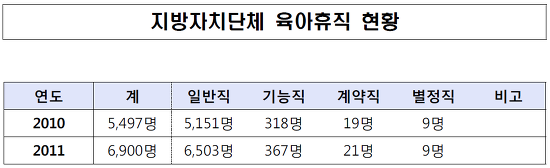
  Seeing at the number of cases, it
is possible to observe that 5479 general public officials in 2010 and 6900
general public officials in 2011 used the maternity leave. As for technical
public officials, 318 people in 2010 and 367 people in 2011 used the maternity
leave. In contrast, only 19 of contract public officials in 2010 and 21 of
contract public officials in 2011 used the maternity leave. As for the public
officials in special services, there were 9 who used the maternity leave in
2010 and 2011.


  However, the above information,
disclosed by the Ministry of Public Administration and Security, is not
efficient to observe the rate using maternity leave among entire public officials.
The number of public officials per type of service has been found in the Korean
Statistical Information Service and the comparison was made with the data
disclosed by the Ministry of Public Administration and Security.


You can find this below.


Year

General Service

Contract Service

Technical Service

Special Service

Total

(Number of current  employees)

Maternity leave usage

Rate

Total

Maternity leave usage

Rate

Total

Maternity leave usage

Rate

Total

Maternity leave usage

Rate

2010

192,307

5151

2.6785%

3990

19

0.4762%

42,989

318

0.7397%

3455

9

0.2605%

2011

192,676

6503

3.3751%

4202

21

0.4998%

42,613

367

0.8612%

3479

9

0.2587%


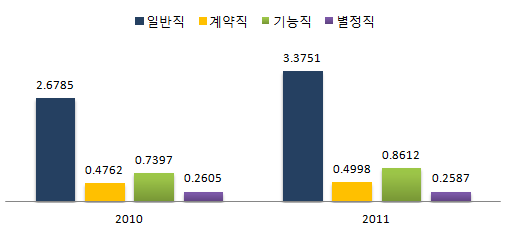
  The public officials in general service use the
maternity leave the most, followed by the public officials in technical
service. The public officials in contract and special service have the lowest
usage of the maternity leave.


  However, it is not possible to say that the use of the
maternity leave in the general public officials is high. Only 3 % of the entire
public officials used the maternity leave. As for the contract public
officials, only 0.5% of them used it.


  The Article 63 of local public officials act
allows to use the maternity leave
in case it is needed to
raise children under age 8 (When at school, same or below 2nd grade of the
elementary school) or when female public officials get pregnant or give birth
.


  Although it is clearly stated in the
laws, the reality shows that the maternity leave is not properly used. The
situation for the contract public officials is even worse. The public officials
in contract service are an exception even in the world of public officials
which is well known for its good stability and welfare system. What the private
companies and small-sized organizations will be like when even public
organizations are in such conditions?


  There should be no distinctions between
men and women when it comes to child care. Also it is not like there is a
classification between the contract service and general service in the standard
of being parents. But in our society, there are more burdens of child care for
women and more difficulties for the contract service.


  The reality seems distant from child
care and nurturing. But the government is encouraging people to have more
babies. This is an empty claim which is not realistic at all.


  Park, the presidential elect, has
pledged to enhance women
s maternity leave and introduce a fathers month to encourage mens paternity leave.
Hopefully, the new government keeps the promise and the parents do not have to
suffer heartache from raising children

by
  • 정보공개센터

정보공개센터는 정부지원 0%, 시민의 후원으로 활동합니다

후원하기
활동소식

Present State of the members of 19th National Assembly holding additional jobs, Hyun Young-hee holds 9 additional jobs, Still a large number of the members holds additional jobs as lawyers and professors

2013.01.22

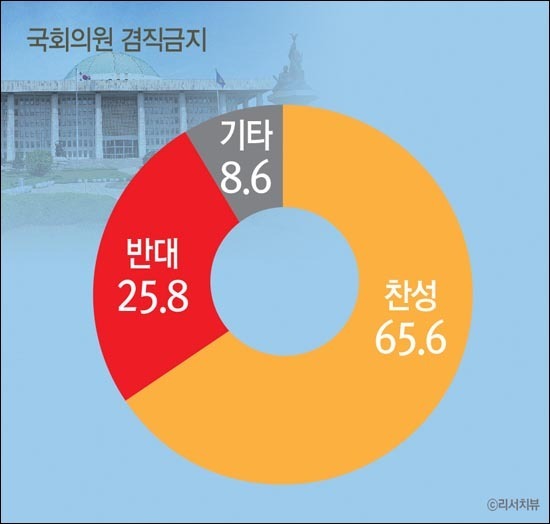
The
result of the opinion poll regarding the prohibition on the members of National
Assembly holding other jobs for the purpose of making profits, Requested by
Ohmynews to Researchview

(Picture:
Ohmynews)


  The
Center of the Freedom of Information (CFOI) has once disclosed the list of
members of the 18
th National Assembly who hold additional jobs and
receive compensation. It was shown that a large number of them serve as the
member of the National Assembly concurrently with other professional types of
jobs such as a lawyer and professor. What about the members of the 19
th
National Assembly? The CFOI has requested information disclosure regarding
their additional jobs.


According
to the <Present State of Additional Jobs Reported by the Members of the 19th
National Assembly>, the members of the 19th National Assembly are
holding 194 additional jobs and 96 of 300 members hold more than one additional
job. This is approximately 32% of the entire members of the National Assembly.
This is a decreased amount compared to the previous time when 42.8% (June
2011), which means 127 out of 297 members of the 18th National
Assembly held additional jobs.


Having
looked at this issue per party, among 96 members holding additional jobs,
Saenuri and Democratic United Party had 55 and 39 members each and Progressive
Justice Party and non-partisan had 1 member each.


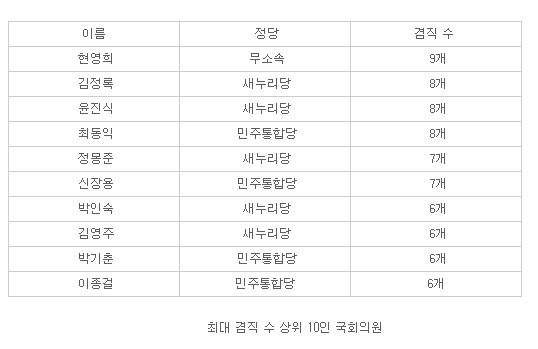
It
was Hyun Young-hee who had the largest number of additional jobs among all.
Hyun Young-hee is serving as a president in 4 organizations including Busan Skating Union, Federation of Busan
Love Bike, the Busan headquarter of National Bike Riding Movement Headquarters

and the supporting association of Busan National University of Education
and she is also the co-representative of Korean
Women Politics Association
. She is holding additional jobs at 9
organizations in total.


In
addition to this, Kim Jeong-rok and Yoon Jin-sik of the Saenuri party and Choi
Dong-ik from the Democratic united party are holding additional jobs. Kim
jeong-rok is the CEO of CPL and the president of Korean Association of Persons with Physical Disabilities. Yoon
Jin-sik is the advisor of Korean Customs
Brokers Association
, the president of Korea
Institute for National Unification and Economics
and the honorary chairman
of the Golf Association of Chungju.
Choi Dong-ik is the president of Korea
Blind Union
and Korea Association of
Welfare Center for the disabled
and the representative of the Korea Differently Abled Federation.


The
fact that there are numerous lawyers and professors among the members of the
National Assembly has been consistently criticized. As for the lawyers, there
is a potential of receiving political funds. As for the professors, they are
keeping their positions without giving lectures under the name of an adjunct
professor or guest professor. Being aware of the criticism, the candidates, who
were also licensed lawyers themselves, pledged in the 2011 April general
election that they will not hold additional jobs when they are elected.


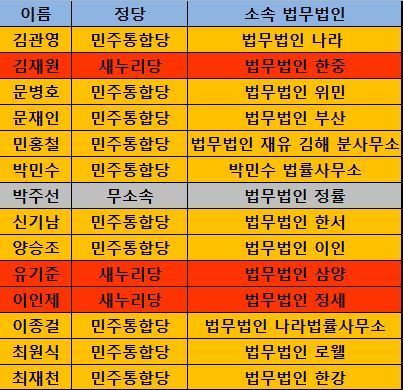
However,
there are still a large number of members who hold additional jobs as lawyers
and professors (incl. adjunct and guest professors). Among 96 members who hold
additional jobs, 32 hold the professor position and 21 holds the lawyer
position. Moreover, 14 of the 21 members holding additional jobs as lawyers
have been receiving compensation from the law firms they belong to.


The
National Assembly is generally recognized as “Lazy National Assembly” and “The
National Assembly with all the privileges”. Due to this, there is a great
distrust towards the politics. Would the citizens think the members of the
National Assembly are doing their best in parliamentary activities when they
are holding numerous jobs at the same time as a tool to add some more lines on
their resumes? The members of the National Assembly, who gets paid by our
taxes, receive double income while holding an additional job as a lawyer at the
law firms. Would this make them appear transparent from the perspective of the
citizens? It seems there is still a long way to go for the National Assembly to
gain recognition from the public.


by
  • 정보공개센터

정보공개센터는 정부지원 0%, 시민의 후원으로 활동합니다

후원하기
활동소식

National Policy Researchers Wastes Money on Business Class

2013.01.22

  The result of the Center of Freedom of Information (CFOI)’s request of
information disclosure to the National Assembly revealed that economics,
humanities and sociology research societies and their related government think
tanks are wasting the budget with business class airline seats. This issue has
been pointed out as a main cause for wasting financial resources as there are
numerous institutions that do not even have criteria for using the business
class and the positions available for the business class even covers general
research fellows. According to the data disclosed by the National Assembly, the
overseas travel expenses for the economics, humanities and sociology research
societies and their related government think tanks are 8.476 billion won in
2013, down 90 million won from 2012 but up 2 billion won from 2011.


[2013 Overseas Travel Expense Budget for Research Societies
and Research Institutes]

                                                                                                     
(Unit: million, %)

Type

Final Accounts 2011

Budget (A)  2012

Budget (B) 2013

Variation

(B-A)

(B-A)/A

Overseas Travel Expenses

6,422

8,574

8,476

98

1.1


[Criteria of boarding business class and number of
boarding]

                                                                                                                  
(Unit: Person)

Name of Institutes

Criteria of Boarding Business Class

Number of boarding

Position

Flight Duration

Location

2011

2012

Science and Technology Policy Institute

Executives (President)

Vice President

Senior Research Fellow

2

2

Head of the department

(excl.
team manager
)

8 hrs +

1

Korea Research Institute for Human Settlements

President

Vice President

2

3

Architecture & Urban Research Institute

President

3

Korea Institute for International Economic policy

President

Senior Research
Fellow

62

56

Research Fellow

8 hrs +

Senior Administrative Officer

Senior Expert Member

6 years + of experience in the corresponding position.

8 hrs +

Korea Institute for Industrial Economics & Trade

President, Vice President

All

9

18

Senior Research Fellow

8 hrs +

Region GaRa

(* America, Europe, Middle East, Africa)

Research Fellow

Chief Administrative Officer

Head of the department

8 hrs +

Korea Energy Economics Institute

President

3

Vice President

1

2

Senior Research Fellow

8
hrs +

7

9

Korea Information Society Development Institute

President

Head of the division

Senior research Fellow

8
hrs +

10

5

Korea Institute for National Unification

President, Auditor

Senior Research Fellow

Chief Administrative Officer

5

5

Korea Development Institute

President

Senior Research Fellow

Research Fellow

78

70

KDI School of Public Policy and Management

Executive

Vice president

Head of the department

Director of the headquarter

Head of affiliated organizations

Senior Research Fellow

Research Fellow

17

10

Korean Educational Development Institute

President

Senior Research Fellow

Ga, Na, 

Da, Ra

6

7

Head of the department

8
hrs + for head of the department

Korea Institute for Curriculum and Evaluation

Executive

Vice President

Senior Research Fellow

Head of the department

(stated
by the organization regulation
)

8 hrs + for Head of the department (stated by the organization regulation )

2

1

The Korea Transportation Institute

President

Vice President

Senior Research Fellow Head of the department (Partly applicable)

Ga, Na, 

Da, Ra

10

7

8 hrs +

Korea Labor Institute

President

Head of the headquarter

Senior Research Fellow

Twice per year

One a year


9

7

Korea Rural Economic Institute

President

Senior Research Fellow

10

6

Research Fellow

8 hrs +

Korea Legislation Research Institute

President

4

4

Senior Research Fellow

Research Fellow

Senior Administrative Officer

8 hrs +

1

0

Korea Institute for Health and Social Affairs

President

Vice President

Senior Research Fellow

President and Vice president  No criteria for the flight duration

Senior Research Fellow

– 8 hrs +

3

5

Korea Institute of Child Care and Education

President

Senior Research Fellow

Flight duration regardless

1

2

Head of the department

8 hrs

Korean Women’s
Development Institute

President

Vice President (an acting president)

Senior Research Fellow (*Head of the department)

8 hrs +

8 hrs +

Korea
Institute of Public Finance

Executive

President, Head

Senior Research Fellow

23

18

Research Fellow

Director of the Office of Administration

Director of Audit

8 hrs +

(economy class applied in case of 8 hrs -)

Korea Research Institute for Vocational Education & Training

President

3

4

National Youth Policy Institute

President

Senior Research Fellow

1

2

Head of the department

8 hrs +

Korea Maritime Institute

President

Vice President Senior Research Fellow

Ga, Na, 

Da, Ra

26

13

Head of the department

8 hrs +

Ga, Na, 

Da, Ra

Korea Institute of Public Administration

President

19

14

Korean Institute of Criminology

President

Senior Research Fellow Head of the department

8 hrs + for Heads of the department

Ga, Na,

Da, Ra

18

14

Korea Environment Institute

President, Vice President

Ga, Na,

Da, Ra

18

14

Senior Research Fellow Head of the department

8 hrs +

– Source: the National Assembly


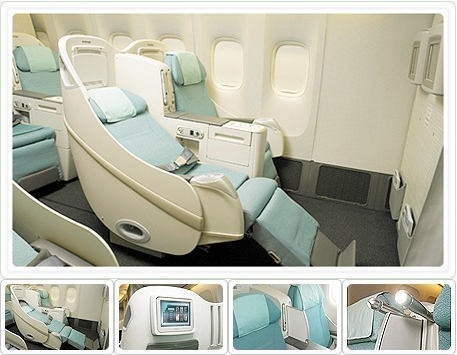
  Having investigated the number of cases that the employees of
economics, humanities and sociology research societies and their related
government think tanks boarded the business class, the result showed that there
were 389 cases in 2011 and 351 cases by early October 2012. In general, the
business class costs more than 2.2 times of the economy class (Incheon –
Newyork).


  However,
the moral hazard seems to be at its peak considering the fact that most of the
institutes provide business class seats to senior research fellows and research
fellows on top of the president. In particular, The Korea
Development Institute and Korea Institute for International Economic policy
have used the business class 148 and 118 times respectively throughout 2 years.
The Korea
Institute of Public Finance also has used 41 times. These institutes had no
criteria for locations in using the business class and they made it possible
for everyone in the position of the research fellow to use the business class.
On the contrary the institutes that only allowed the president and vice
president to use the business class have less cases of the business class
usage.


 Even the National Assembly said that When there is a
big difference among the institutes in the criteria of positions and using
conditions of boarding the business class in case of the business trips abroad,
it may cause a problem of fostering an atmosphere of social disharmony and
reduce job satisfaction. As for the institutes that have set loose criteria on
positions and using conditions, it is highly likely to waste money because the
expenses for overseas flights are allocated too much compared to that of the
government, public institutions and other government think tanks.


  Park, the
presidential elect, has instructed to reduce the budgets of each government
department in order to secure resources for the welfare. But seeing at the current
state of researchers
business class usage makes us realize how they
splurge our taxes. Lately there was a story of an old man who died after
sleeping without turning on the heater. It is doubtful whether the research
fellows can study the lives of commoners while using the business class. This
kind of practice should certainly disappear in our society.


by
  • 정보공개센터

정보공개센터는 정부지원 0%, 시민의 후원으로 활동합니다

후원하기